Technical Field Note #29 · November 2026
How much of a real workday is walking? The IMU says 6%, in 73 short trips an hour
Field Note #29 · Activity split from IMU for egocentric stereo+IMU capture (ODL-EGO S1), 10 working days
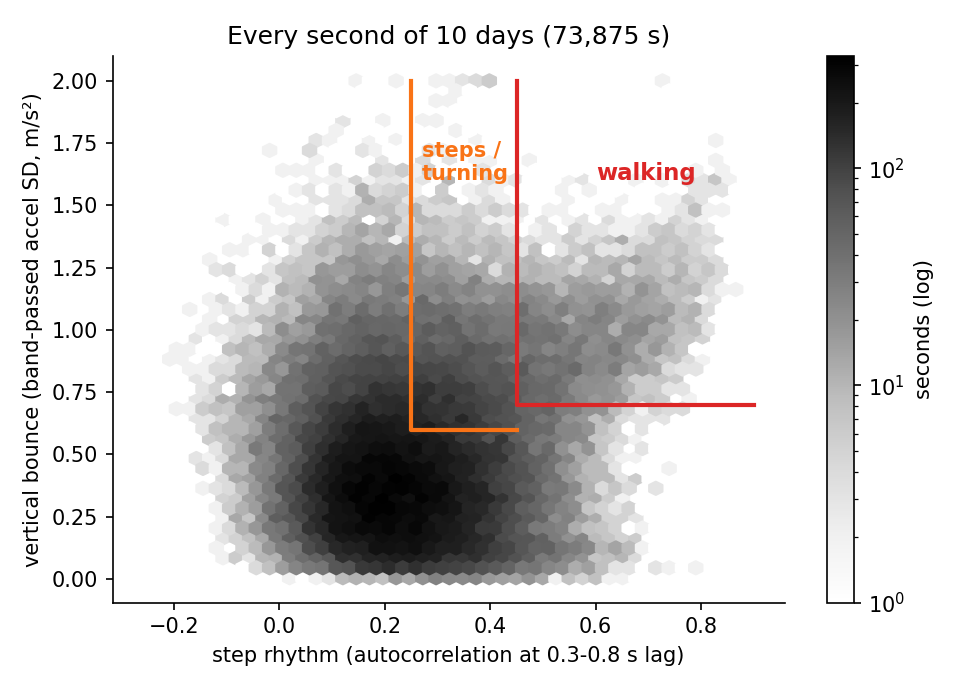
Buyers of egocentric data ask what share of a workday is manipulation at a station and what share is moving around. We answered from the head-mounted IMU alone, for every second of ten working days (73,875 s, 20.5 hours) at one produce-portioning site. Each second got two gait features from the accelerometer: how strongly the head bounced in the 0.8–3.5 Hz walking band, and how regular that bounce was at a step period of 0.3–0.8 s. The wearer stood without stepping in 82.1% of seconds, took short steps or turned in 12.0%, and clearly walked in 5.9%, about 3.5 minutes per hour. Walking came in short trips: about 73 bouts per hour, median 3 seconds, the longest 24 seconds. The split was nearly the same on every day (walking 4.4–7.6%). Standing periods supplied 91% of the seconds usable for manipulation learning. Checked by eye, the feet were moving in 22 of 24 seconds the IMU called walking and in 1 of 24 it called standing.
Why this matters
Manipulation data and locomotion data are different products
Robot-learning buyers want different things: some need hands at a workstation, others need people moving through a space. A recorded hour from a real workplace mixes both, and the mix decides what the hour is worth to each buyer.
Video can show the mix, but checking 20 hours by eye is slow. The head-mounted rig already records an accelerometer at about 500 Hz, so we asked how far that alone gets.
Setup
Two gait features per second from the accelerometer
Data: every second of ten working days, 2026-11-01 to 11-12, produce portioning for school meals, one R8 stereo+IMU rig (ODL-EGO S1) on the wearer's head; 73,875 seconds with IMU (20.5 h). Five days in work gloves, five bare-handed.
Per second, over a 4-second window centred on it: the acceleration magnitude, band-passed to 0.8–3.5 Hz (the head bounce of walking), gives "bounce" as its standard deviation; its autocorrelation peak at a lag of 0.3–0.8 s gives "rhythm". Walking: bounce > 0.7 m/s² and rhythm > 0.45. Short steps or turning: bounce > 0.6 m/s² and rhythm 0.25–0.45. Everything else: standing.
Check: 24 random seconds from each class were viewed as three frames over 1.4 s and marked by eye for whether the wearer's feet were moving.
Finding 1
Four-fifths of the day is standing at the work
The wearer stood without stepping in 82.1% of seconds, took short steps or turned in 12.0%, and clearly walked in 5.9% (about 3.5 minutes per hour). The median step period in walking seconds was 0.59 s, a normal indoor pace.
The split hardly moved from day to day: standing 78–86%, walking 4.4–7.6%. Gloves made no difference here (walking 5.5% on glove days, 6.4% bare-handed).
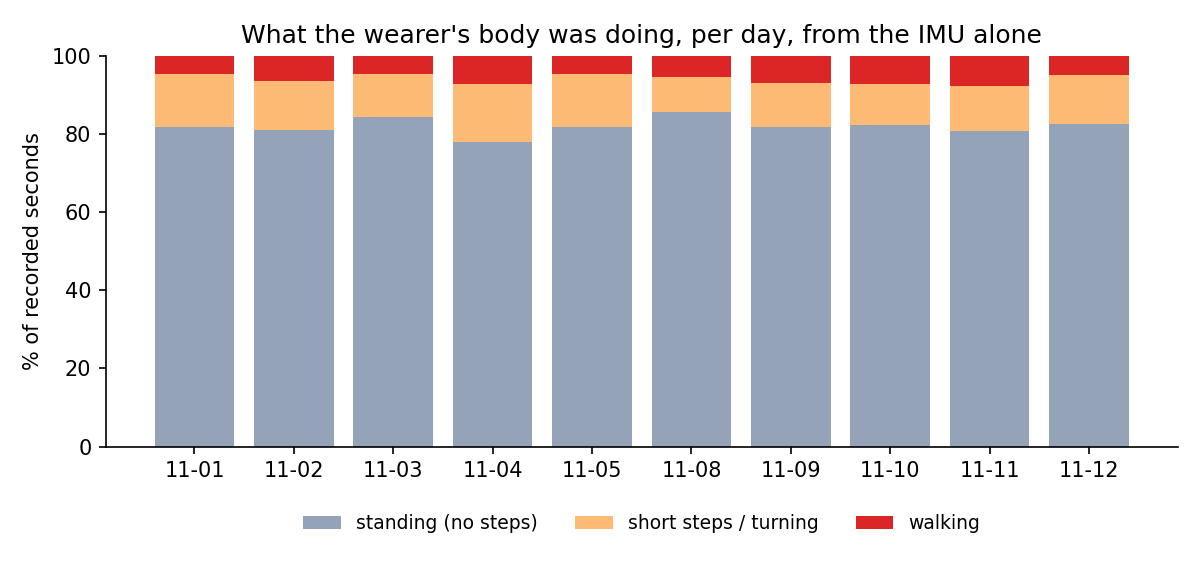
| Date | Hands | Standing % | Short steps / turning % | Walking % |
|---|---|---|---|---|
| 11-01 | gloves | 81.7 | 13.8 | 4.4 |
| 11-02 | gloves | 81.1 | 12.4 | 6.5 |
| 11-03 | gloves | 84.3 | 11.0 | 4.7 |
| 11-04 | gloves | 78.0 | 14.9 | 7.2 |
| 11-05 | gloves | 81.9 | 13.6 | 4.5 |
| 11-08 | bare | 85.6 | 9.0 | 5.4 |
| 11-09 | bare | 81.9 | 11.3 | 6.8 |
| 11-10 | bare | 82.3 | 10.6 | 7.0 |
| 11-11 | bare | 80.8 | 11.6 | 7.6 |
| 11-12 | bare | 82.6 | 12.5 | 4.8 |
Finding 2
Walking comes in short trips
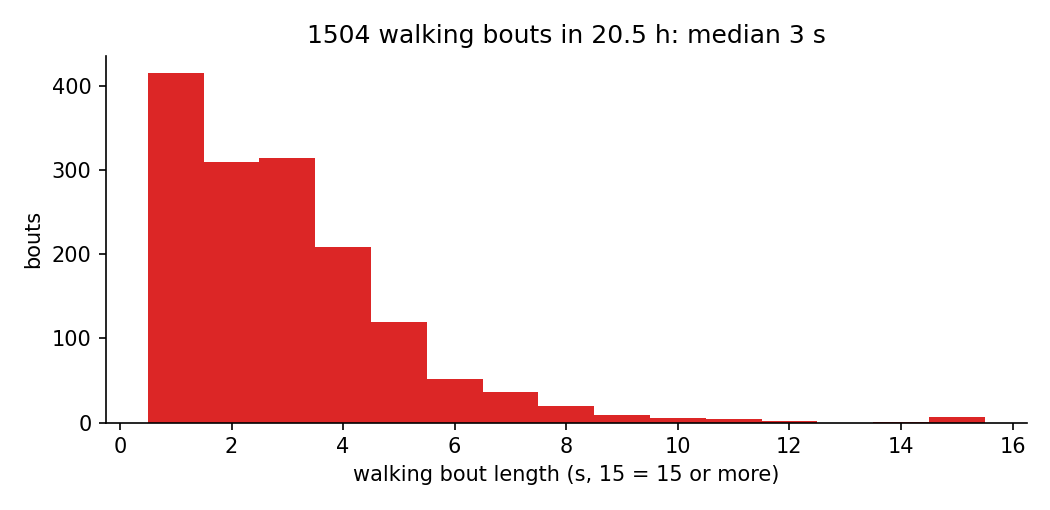
Walking seconds formed about 1,500 bouts in 20.5 hours: 73 per hour, median 3 seconds, 90th percentile 5 seconds, longest 24 seconds. Bouts of 3 seconds or more occurred 38 times per hour. This site is a compact room: the wearer turns to a shelf, carries a box a few metres, comes back.
For a locomotion buyer this hour holds a few minutes of walking, almost all in pieces under 6 seconds.
Finding 3
Usable manipulation time comes from standing
Camera blur passed in 82% of standing seconds and 81% of walking seconds (blur here is from head rotation, which is similar in both), but only 69% during short steps and turns. Hands were found in 50% of standing seconds and in 23–28% of moving seconds. As a result, 42% of standing seconds were usable for manipulation versus 18–19% of moving seconds, and standing supplied 91% of all usable seconds.
Checked by eye, the feet were moving in 22 of 24 walking seconds (2 unclear), in 11 of 24 short-step seconds (4 unclear) and in 1 of 24 standing seconds. The walking class is reliable; the short-step class is a mix of real steps and brisk turns at the bench.
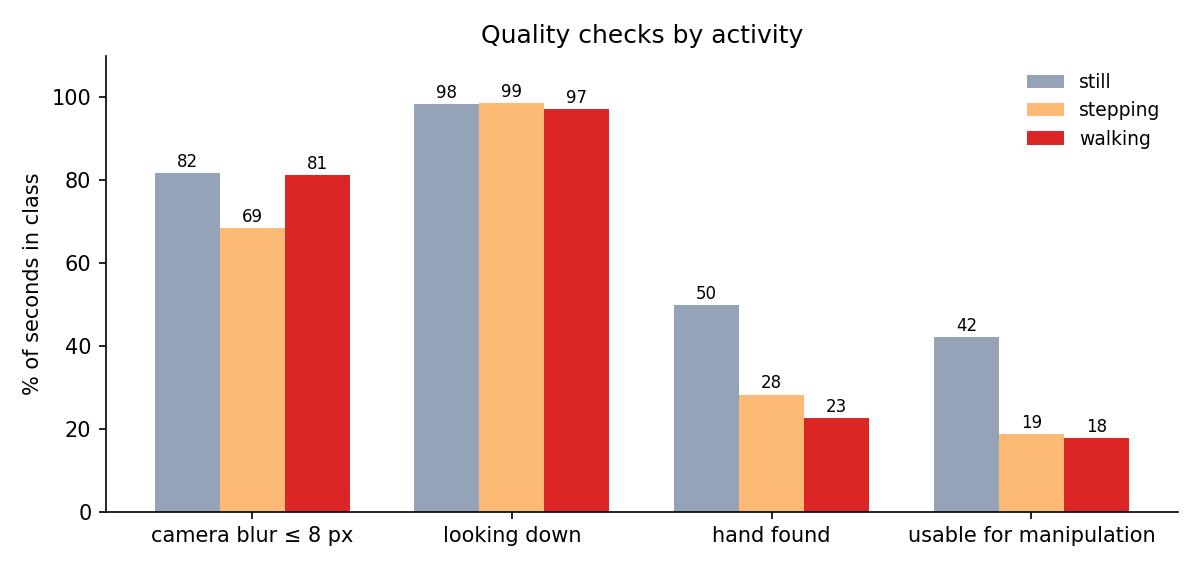
| Standing | Short steps / turning | Walking | |
|---|---|---|---|
| Share of recorded seconds | 82.1% | 12.0% | 5.9% |
| Head rotation, median | 20°/s | 36°/s | 33°/s |
| Camera blur ≤ 8 px | 82% | 69% | 81% |
| Hand found | 50% | 28% | 23% |
| Usable for manipulation | 42% | 19% | 18% |
| Feet moving, checked by eye | 1 / 24* | 11 / 24 (4 unclear) | 22 / 24 (2 unclear) |
What we changed
Activity labels ship with the data
Every delivery now carries a per-second activity label from the IMU:
- Standing, short steps/turning or walking, with the two IMU features, so a buyer can choose their own thresholds.
- Manipulation buyers can filter to standing seconds; locomotion buyers can see up front how much walking a site offers and in what bout lengths.
- Sites are profiled in the first hours of capture, before a buyer commits to volume.
What this means
A cheap, early profile of what a site produces
Verified: from the IMU alone, this site is 82% standing, 12% short steps and 6% walking, stable over ten days, with walking in short trips of about 3 seconds.
Reviewed on a small sample: the walking label matched the video in 22 of 24 seconds with none wrong.
For buyers: ask how much of the recorded time is the activity you need, and in what bout lengths. A workplace that looks busy can still offer very little continuous walking.
SCOPE AND LIMITS
Limitations
What this note does not show, stated up front.
- One compact indoor site, one wearer, one rig; walking share depends heavily on site layout and task.
- Thresholds were set from this data and checked on 72 seconds by eye; the short-step class is mixed. *The standing check sampled seconds with bounce below 0.6 m/s², which is most but not all of the standing class.
- Walking is detected from head bounce; shuffling, sideways steps or walking while carrying something heavy may be missed or labelled short steps.
- Preliminary analysis: AI-assisted automated analysis plus a small manual review; no third-party review.
FAQ
Questions data buyers ask
Q01How much of a real workday is walking in egocentric capture?
Q02Can walking be detected from a head-mounted IMU alone?
Q03How long are walking bouts in an indoor workplace?
OPEN DATA AND CODE
Reproduce and inspect the evidence
Every number in this note can be checked: derived tables, analysis code, figures and a runnable notebook are public.
 GitHubAnalysis code and reproduction steps
origin-data-lab/walking-vs-standing-real-workday-imuView repository  Hugging FaceDataset card, tables and figures
origin-data-lab/walking-vs-standing-real-workday-imuOpen dataset  Data explorer and runnable notebook
origindatalab/odl-walking-vs-standing-real-workday-imuExplore on Kaggle Licence: CC BY 4.0 (data and figures) · MIT (code)
Origin Data Lab (2026). Technical Field Note #29: How much of a real workday is walking? https://origindatalab.io/technical-field-notes/walking-vs-standing-real-workday-imu.html
CONTINUE READING
Related field notes
Want this measured on your data?
Origin Data Lab plans and runs egocentric, stereo+IMU and field video capture with documented QA, for physical AI and robotics teams.