Capture Architecture • Field Production • Data Engineering

Real-World & Multimodal Data Production for Physical AI & Robotics

We design and operate project-specific data programs from capture architecture and managed field collection through Human GT, multimodal metadata, quality validation, and engineering-ready delivery for Physical AI, robotics, computer vision, and autonomous systems.

  • Managed Field Collection
  • Multimodal Capture
  • Human GT
  • Sensor Metadata
  • Quality Validation
  • Engineering-Ready Delivery
Production Workflow

Requirements to Engineering-Ready Data

Managed Production
Define Requirements Target tasks, environments, sensors, schemas, and acceptance criteria
Configure Capture Camera, stereo, wearable, RGB-D, IMU, or project-specific hardware configuration
Produce in the Field Managed collection with trained operators, task protocols, and field controls
Validate & Structure Sensor checks, metadata, Human GT, QC, traceability, and exception handling
Engineering Delivery Structured multimodal data, manifests, documentation, and buyer-ready packages
VIDEO SENSOR DATA METADATA HUMAN GT QA + MANIFESTS
Core Data Services

From Capture Architecture to Engineering-Ready Delivery

Each layer can be scoped independently or combined into a managed end-to-end program spanning capture design, field production, Human GT, metadata, validation, and structured delivery.

SERVICE 01

Capture Architecture & Field Production

Project-specific capture systems, field workflows, environments, participants, sensors, and acceptance criteria are configured around the target model and task.

Egocentric Stereo / Multi-View Wearable / IMU RGB-D / Spatial Robotics Interfaces
Project-configurable capture
SERVICE 03

Metadata, Synchronization & QA

Sensor metadata, timestamps, synchronization records, validation checks, exception logs, and QC documentation make datasets easier to review, trace, and integrate.

Sensor Metadata Timestamps Sync Records QA Reports Traceability
Traceable technical validation
SERVICE 04

Engineering-Ready Delivery

Validated multimodal data is organized and packaged with schemas, manifests, documentation, metadata, QA records, and project-defined delivery formats.

JSON / CSV COCO / YOLO Manifests Documentation Delivery Packages
Ready for downstream engineering
One layer or a complete managed data program

Scope is defined from model requirements, target tasks, capture conditions, sensors, metadata, quality rules, and delivery requirements.

VIDEO SENSOR DATA ANNOTATIONS METADATA
Human Verification & Human GT

Automation Handles Volume. Humans Resolve the Exceptions.

Automated processing reduces repetitive work, while targeted human review corrects missed objects, false positives, inconsistent labels, and difficult scenes before final delivery.

Verification Workflow
01
Automated Output Initial detections, annotations, or processed media are generated through the approved automated workflow.
02
Exception Detection Low-confidence results, missed regions, scene changes, and quality warnings are separated for review.
03
Human Correction Reviewers correct false positives, missing objects, alignment errors, labels, and uncertain records.
04
Human-Verified GT Approved records can be marked as human-verified for training, validation, evaluation, or downstream QA.
Human Review Layer

Review Effort Is Focused Where Automation Is Least Reliable

Instead of treating every frame or annotation equally, review can focus on exceptions, difficult scenes, uncertain outputs, and records that directly affect delivery quality.

01 Missed Objects

Find and correct objects or privacy regions that were not detected during automated processing.

02 False Positives

Remove incorrect detections, duplicate regions, and unnecessary annotations.

03 Label & Box Accuracy

Correct class labels, bounding boxes, alignment, and project-specific annotation rules.

04 Temporal Consistency

Review flicker, unstable detections, scene transitions, and inconsistencies across video frames.

Auto-Generated Human-Corrected Human-Verified
Verification depth is defined during project scoping

Delivery can include automated outputs, exception-only review, corrected annotations, human-verified ground truth, or a combination of these stages according to the required quality, cost, and turnaround.

Engineering-Ready Delivery

Delivered as an Organized Dataset Package, Not a Loose File Dump

Processed assets, labels, metadata, manifests, and quality records are organized into a structure your engineering team can inspect, version, and connect to downstream training or evaluation workflows.

Delivery Validated

project_delivery_v1/

/customer/project/versioned-delivery/

01 source_assets/ original media
02 processed_assets/ verified output
03 annotations/ labels & GT
04 metadata.json asset records
05 manifest.json file inventory
06 qa_report.pdf quality summary
Delivery Specification

Built Around the Customer’s Downstream Workflow

Delivery structure is defined from the required framework, annotation schema, source assets, metadata fields, version rules, and intended engineering use.

Media Assets Video, images, extracted frames, processed derivatives, and approved source separation.
Annotations Bounding boxes, labels, Human GT, review status, and project-specific annotation records.
Metadata File identity, processing status, scene attributes, exceptions, and verification records.
Documentation Manifest, schema notes, naming rules, QA summary, exclusions, and delivery history.
COCO YOLO JSON CSV MEDIA CUSTOM SCHEMA
Format support is confirmed during sample review

Project-specific conversion depends on the source schema, target format, required validation, and downstream system.

Privacy Processing

Automated Face and License Plate Blur With Human Review

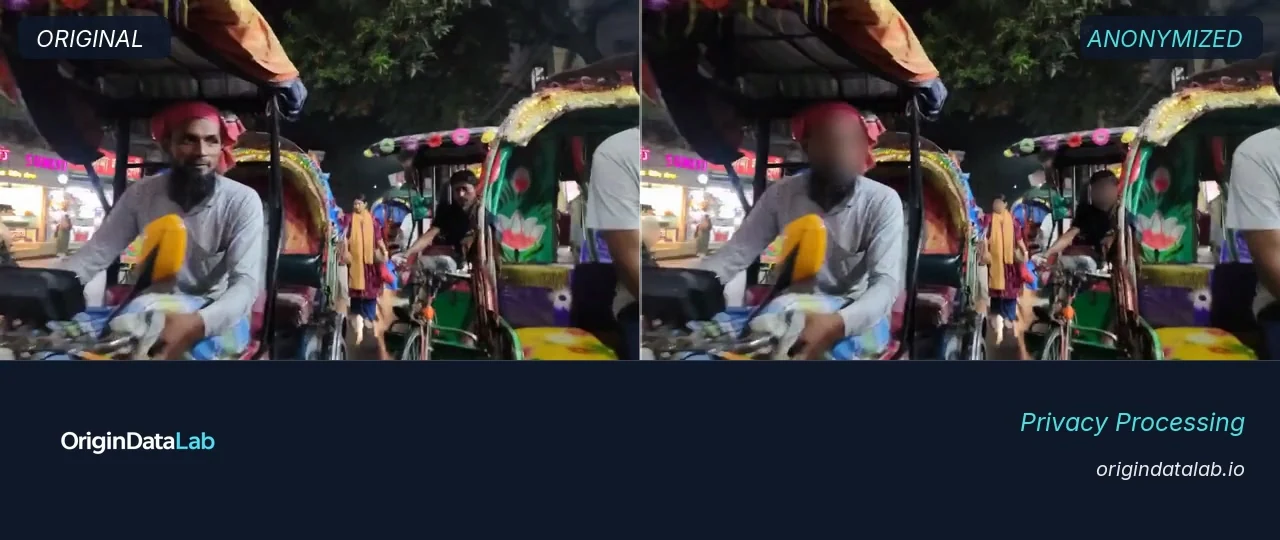
Real-world video and image data can be processed to reduce exposure of identifiable faces and license plates. Automated detection handles the first pass, while uncertain, missed, or difficult regions can be reviewed and corrected by people.

Before / After Evaluation Public Release V58
Before and after privacy anonymization example showing automated face processing in challenging real-world footage Watch Public Demo
Public Evaluation Release V58 — privacy anonymization demonstrated on challenging real-world footage with low light, motion, occlusion, and small subjects. Difficult regions may require Human GT review.
Face Processed Plate Processed Human Review Required
Automated processing reduces repetitive manual work

Human review remains available for missed regions, uncertain detections, small objects, difficult lighting, occlusion, and frame-to-frame inconsistency.

Anonymization Workflow

Automation First. Human Correction Where It Matters.

Detection rules, blur treatment, review depth, and acceptance criteria are defined after representative sample footage has been evaluated.

01
Sample Evaluation We inspect source quality, object size, camera movement, lighting, viewpoints, and region-specific plate conditions.
02
Automated First-Pass Processing Face and license plate regions are detected and processed through the approved video or image workflow.
03
Exception-Based Human Review Reviewers inspect missed, uncertain, false-positive, unstable, and difficult privacy regions.
04
Corrected Delivery & QA Approved outputs can include corrected media, exception records, processing summaries, and QA documentation.
Privacy processing is confirmed through a representative pilot

We do not claim that every submitted file is automatically or completely anonymized without evaluation. Final scope, target objects, review depth, quality criteria, and delivery conditions are confirmed for each project.

Pilot-Based Service
Project Workflow

From Representative Sample to Structured Final Delivery

Every project begins with a defined requirement and representative sample. Workflow, review depth, quality targets, delivery structure, and production scale are confirmed before larger processing begins.

Engagement Process
01
Requirements & Project Scope We review the source data, target output, processing goal, quality expectations, privacy requirements, formats, timeline, and delivery conditions.
Define
02
Representative Sample Review A limited sample is examined to evaluate feasibility, source quality, difficult cases, workflow design, and expected human-review effort.
Evaluate
03
Pilot Processing A focused pilot validates processing rules, correction methods, QA criteria, delivery format, and expected production performance.
Validate
04
Controlled Production The approved workflow is applied to the agreed dataset with processing logs, human review, exception handling, and ongoing quality checks.
Process
05
QA & Engineering Delivery Approved assets, annotations, metadata, exception records, manifests, and project documentation are organized into the confirmed delivery structure.
Deliver
Video Images Annotations Metadata QA Delivery

Frequently Asked Questions

Questions About Data Processing and Verification

These answers explain how source-data review, human verification, metadata, quality assurance, privacy processing, delivery formats, and pilot scoping are handled.

01 What types of source data can you process?

Origin Data Lab can review video, image, extracted-frame, annotation, and metadata packages. Technical feasibility depends on file format, media quality, dataset size, target objects, and required output.

02 Can you anonymize faces and license plates?

Yes. Face and license plate anonymization is available through sample-based pilot evaluation. The pilot defines detection rules, blur treatment, human-review depth, and quality criteria.

03 Is the anonymization process fully automated?

No. Automated detection is used for the first processing pass, while difficult scenes, missed regions, false positives, and uncertain results may require human review and correction.

04 What does Human GT mean in your workflow?

Human GT refers to annotations or detection results that have been inspected, corrected, and verified by a human reviewer. Outputs can be marked as automated, human-corrected, or human-verified.

05 Can you review only uncertain frames or exceptions?

Yes. Human review can focus on key frames, low-confidence detections, missed objects, false positives, temporal inconsistencies, and other exception cases.

06 Which annotation and delivery formats are supported?

Delivery may include COCO, YOLO, JSON, CSV, media files, extracted frames, metadata records, manifests, QA summaries, and project-specific folder structures.

07 Can you generate metadata and QA documentation?

Yes. Depending on the approved scope, delivery may include file metadata, processing status, verification status, exception logs, completeness checks, schema validation, manifests, and QA summaries.

08 Can we begin with a small pilot?

Yes. A limited pilot is recommended before full production to evaluate source quality, processing accuracy, human-review effort, exception patterns, delivery format, and expected turnaround.

09 Can you work under an NDA or controlled-delivery process?

Project-specific NDA terms, access conditions, retention rules, source-file handling, delivery controls, and deletion requirements can be discussed before data is transferred.

10 How are pricing and timelines calculated?

Pricing and timelines depend on media duration or image volume, source quality, target-object complexity, automated processing performance, human-review depth, output requirements, and quality-assurance scope.

Start With a Sample

Share a Representative Data Sample.
We’ll Review the Most Practical Workflow.

Tell us what needs to be anonymized, verified, corrected, converted, or documented. We’ll review the source data, expected output, quality requirements, and recommend a focused pilot before larger-scale processing begins.

Discuss Your Data Project →

Scope, source format, review depth, security requirements, delivery structure, pricing, and timeline are confirmed before production processing begins.