Technical Field Note #27 · November 2026
Ten working days, every second checked: work gloves halved the usable time, because the hand detector missed gloved hands
Field Note #27 · Usable-time QC for egocentric stereo+IMU capture (ODL-EGO S1), 74,044 seconds across 10 working days
Field Note #25 measured usable time for one day. Here the same per-second checks run over every second recorded in ten working days at the same produce-portioning site (2026-11-01 to 11-12, 20.6 hours, 74,044 seconds, one R8 stereo+IMU rig). Exposure was fine in 99.9% of seconds, camera blur stayed under 8 px in 80%, and the wearer looked down at the work in 98%. The hand check decided the rest: 37.9% of all seconds (7.8 h) passed every check. The ten days split cleanly in two. On 11-01 to 11-05 the worker wore cotton work gloves with red rubber palms; from 11-08 on, bare hands. Usable time was 18–28% on every gloved day and 49–56% on every bare-hand day. Checking 30 random seconds from each period by eye showed that hands were visible about as often (22/30 vs 25/30); the detector found 11 of 22 visible gloved hands but 22 of 25 bare ones. Gloves did not make the footage worse; they made the standard hand detector miss half of the hands.
Why this matters
Recorded hours are not usable hours, and the gap depends on things nobody writes down
A robot-learning buyer pays for seconds in which the hands are doing the task, sharp enough to see. Field Note #25 measured that share for a single day. Buyers also ask whether that number holds over weeks, and what moves it.
Over ten working days of the same task, the number moved from about one quarter to about one half of each day, and the cause turned out to be a single detail of the scene.
Setup
The Field Note #25 checks, run on every second of ten days
Data: every left-eye recording from 2026-11-01 to 11-05 and 11-08 to 11-12, produce portioning for school meals, one R8 stereo+IMU rig (ODL-EGO S1), 1600×1200 at 30 fps. 271 files, 20.6 hours; two aborted files under 2 KB were skipped.
Per second: the keyframe that opens each second (the rig writes one per second) for brightness, clipping and hands; that keyframe's exposure time and the gyroscope over the second for camera blur (90th percentile, px); the accelerometer for view direction. Hands: MediaPipe Hands on the full frame and on the lower work region, as in Field Note #23. A second is usable for manipulation when exposure is OK, blur ≤ 8 px, the wearer looks at least 30° down, and a hand is found.
Reading only the keyframes from each file's sample table cut the data read per file from about 250 MB to 22 MB with identical values; the whole index took about 1.5 hours on a 2-core CPU.
Finding 1
Ten days, 37.9% usable, and two very different halves
Exposure (99.9%) and view direction (98.3%) almost never failed. Camera blur removed about one second in five (80.1% passed). The hand check was the main filter: a hand was found in 45.8% of seconds, and 37.9% passed everything (7.8 of 20.6 hours).
By day, usable time was 18–28% on the first five days and 49–56% on the last five. The image checks were nearly the same in both halves; only the hand check changed.
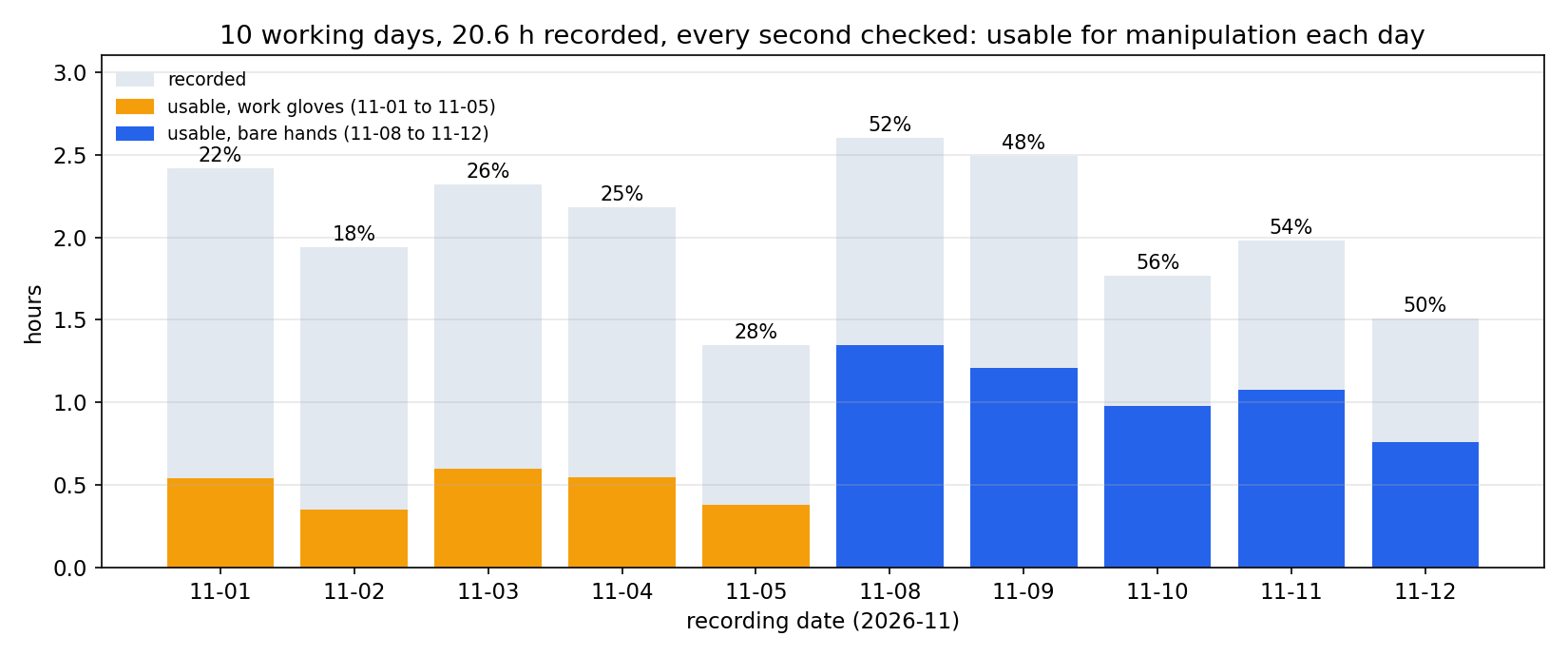
| Date | Hands | Recorded (h) | Image usable % | Hand found % | Usable for manipulation % | Usable (h) |
|---|---|---|---|---|---|---|
| 11-01 | gloves | 2.42 | 78.7 | 27.4 | 22.2 | 0.54 |
| 11-02 | gloves | 1.94 | 78.9 | 22.9 | 18.3 | 0.35 |
| 11-03 | gloves | 2.32 | 78.5 | 31.4 | 25.9 | 0.60 |
| 11-04 | gloves | 2.18 | 77.0 | 30.9 | 25.3 | 0.55 |
| 11-05 | gloves | 1.35 | 78.5 | 34.5 | 28.0 | 0.38 |
| 11-08 | bare | 2.60 | 85.7 | 59.4 | 51.7 | 1.34 |
| 11-09 | bare | 2.49 | 81.2 | 59.1 | 48.5 | 1.21 |
| 11-10 | bare | 1.77 | 80.4 | 67.6 | 55.5 | 0.98 |
| 11-11 | bare | 1.98 | 81.1 | 64.9 | 54.4 | 1.08 |
| 11-12 | bare | 1.51 | 78.4 | 62.1 | 50.5 | 0.76 |
Finding 2
The difference was work gloves
On 11-01 to 11-05 the worker wore cotton work gloves with red rubber palms; from 11-08, bare hands. Site, rig, wearer, task and detector stayed the same.
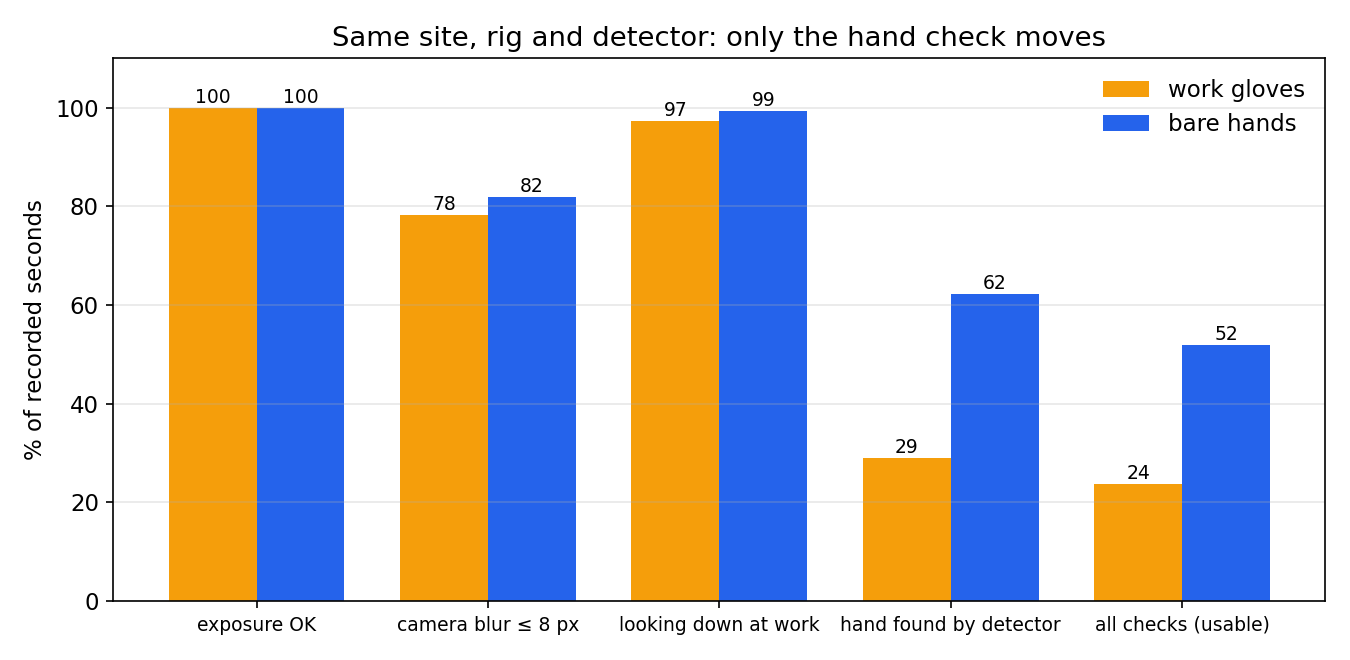
| Work gloves (5 days) | Bare hands (5 days) | |
|---|---|---|
| Recorded | 10.22 h | 10.35 h |
| Exposure OK | 99.9% | 99.9% |
| Camera blur ≤ 8 px | 78.3% | 81.8% |
| Looking down at the work | 97.3% | 99.3% |
| Hand found by detector | 29.1% | 62.2% |
| Usable for manipulation (all checks) | 23.7% (2.42 h) | 51.9% (5.38 h) |
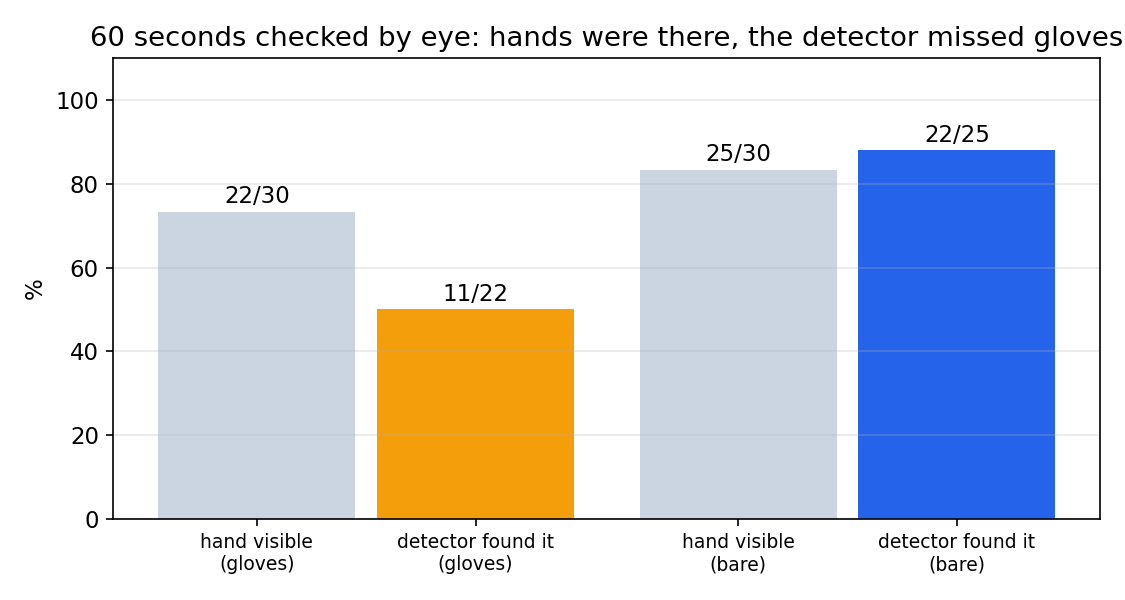
| Hand visible, 30 seconds checked by eye | 22 / 30 | 25 / 30 |
| Detector found the visible hand | 11 / 22 (50%) | 22 / 25 (88%) |
Finding 3
Hands were there; the detector did not see the gloves
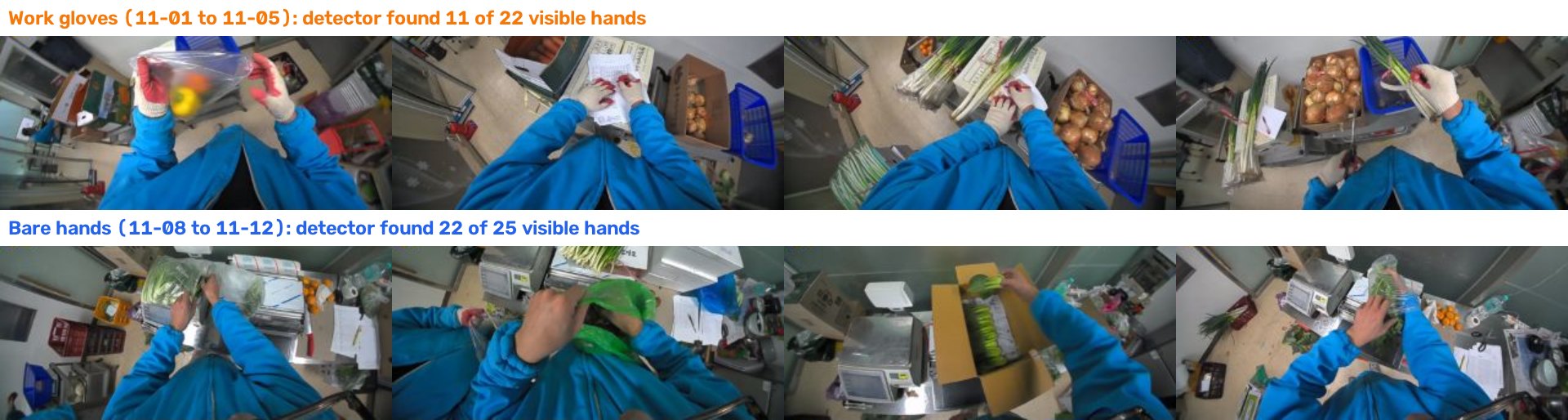
Fewer hands found could mean fewer hands in view or a detector that misses them. We took 30 random seconds from each period that passed the image and view checks and marked by eye whether the wearer's hand was visible. Hands were visible in 22 of 30 glove seconds and 25 of 30 bare-hand seconds. The detector found 11 of the 22 visible gloved hands (50%) and 22 of the 25 bare hands (88%), with no false detections in either set.
Correcting for that, roughly 55% of glove-day seconds and 68% of bare-hand seconds would have a visible hand in a usable image. The glove footage is not worse; its hands are simply invisible to a detector trained mostly on skin.
What we changed
Glove policy and a glove-aware check
Two practical consequences for production:
- Where the task allows it, capture bare-handed: on this site it doubled the seconds that pass an automated hand check (we capture bare-handed now).
- Where gloves are required (food, chemicals, sharp tools), a skin-trained detector undercounts by about half; usable time is then estimated with a glove-specific check and a reviewed sample, not reported from the detector alone.
- Every delivery reports usable time per day, with the check that produced it.
What this means
Usable time is measurable, stable within a setup, and sensitive to details
Verified: over 20.6 hours in ten days, 37.9% of seconds passed all checks; within each setup the daily value was stable (18–28% gloved, 49–56% bare).
Measured by eye on a small sample: gloves halved detector recall (50% vs 88%) while hand visibility stayed similar.
For buyers: ask a vendor for usable time per day and how hands were detected. A single number without the conditions behind it can be off by a factor of two.
SCOPE AND LIMITS
Limitations
What this note does not show, stated up front.
- One site, one wearer, one rig; gloves and bare hands were on different days, so other small differences (layout, produce mix) are not separated from the glove effect. Image and view checks were nearly the same in both periods.
- The by-eye review covers 30 seconds per period; the 50% and 88% recall values are approximate.
- Exposure time per second comes from the keyframe that opens it; Field Note #25 used every frame. On 11-08 the two give 51.7% and 49.2% usable (the day also includes short recordings left out of #25).
- Preliminary analysis: AI-assisted automated analysis plus a small manual review; no third-party review.
FAQ
Questions data buyers ask
Q01How much of recorded egocentric work video is usable for robot manipulation learning?
Q02Do work gloves affect hand detection in egocentric video?
Q03Is usable time stable from day to day?
Q04How was every second checked so quickly?
OPEN DATA AND CODE
Reproduce and inspect the evidence
Every number in this note can be checked: derived tables, analysis code, figures and a runnable notebook are public.
 GitHubAnalysis code and reproduction steps
origin-data-lab/ten-day-usable-time-qc-work-gloves-vs-bare-handsView repository  Hugging FaceDataset card, tables and figures
origin-data-lab/ten-day-usable-time-qc-work-gloves-vs-bare-handsOpen dataset  Data explorer and runnable notebook
origindatalab/odl-usable-time-qc-gloves-vs-bareExplore on Kaggle Licence: CC BY 4.0 (data and figures) · MIT (code)
Origin Data Lab (2026). Technical Field Note #27: Ten working days, every second checked: work gloves halved the usable time. https://origindatalab.io/technical-field-notes/ten-day-usable-time-qc-work-gloves-vs-bare-hands.html
CONTINUE READING
Related field notes
Want this measured on your data?
Origin Data Lab plans and runs egocentric, stereo+IMU and field video capture with documented QA, for physical AI and robotics teams.