Technical Field Note #26 · November 2026
Does the factory stereo calibration still hold after 11 days of head-mounted work? Nine days checked against the scene
Field Note #26 · Calibration stability for egocentric stereo+IMU capture (ODL-EGO S1): same rig, same factory file, nine working days
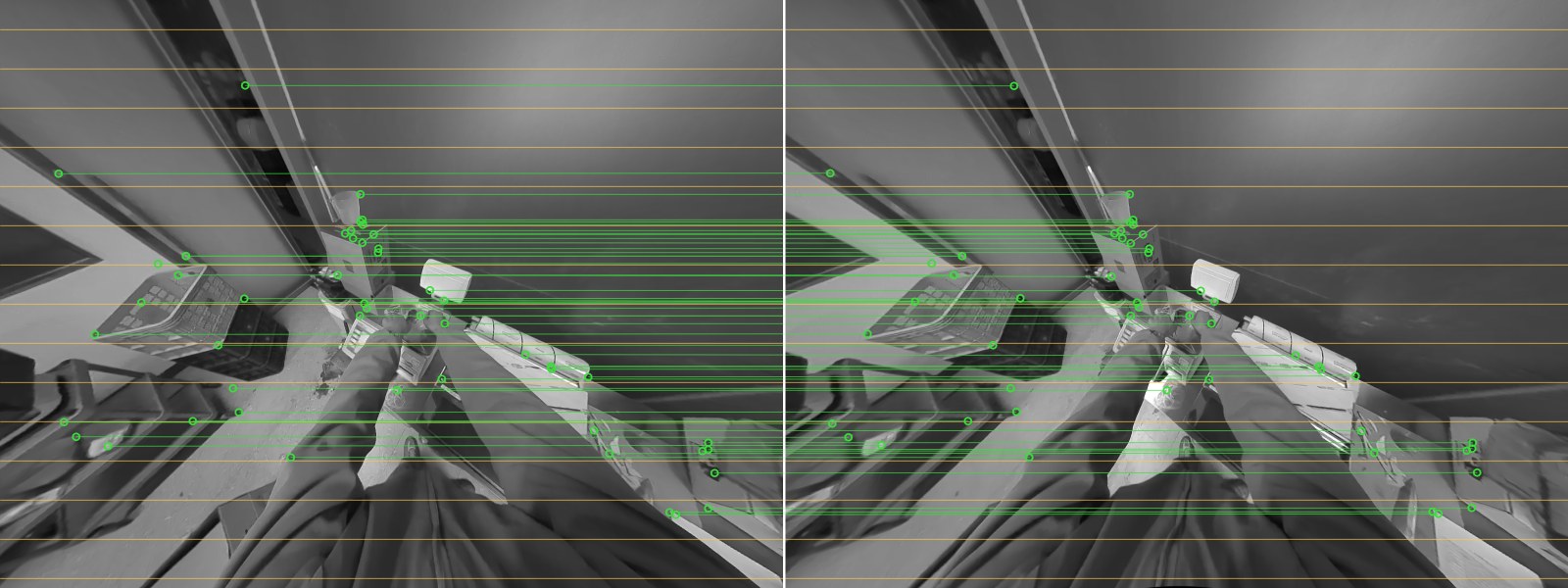
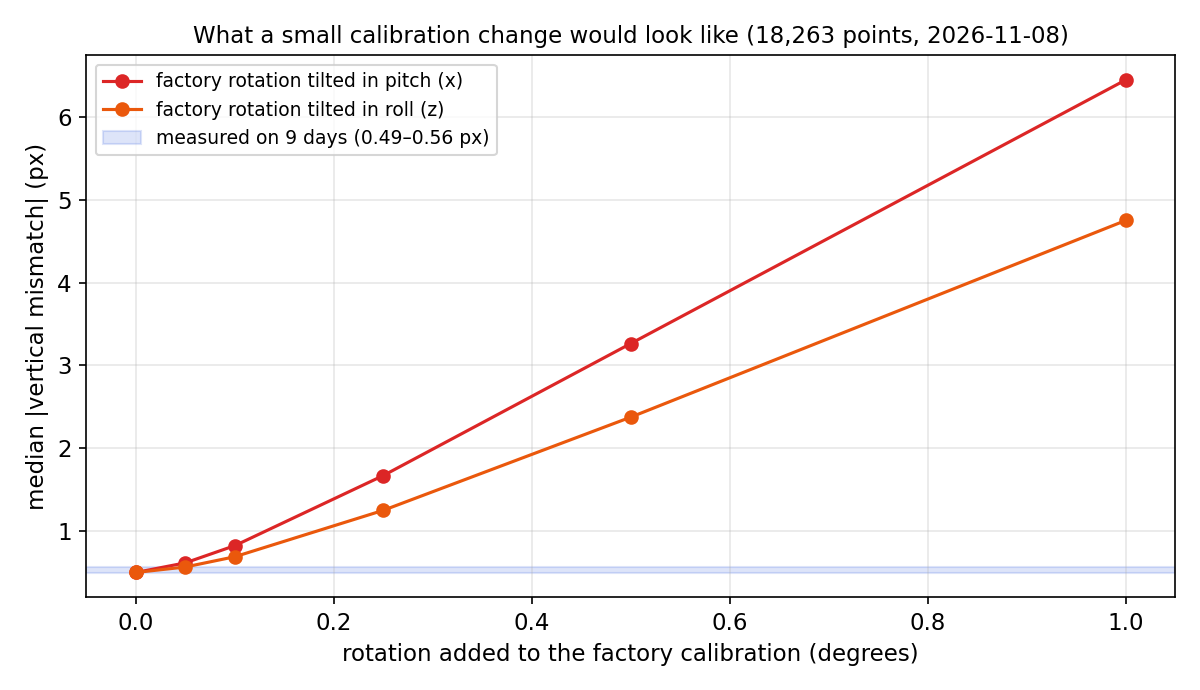
A stereo camera gives metric 3D only while its calibration is right, and a head-mounted rig is knocked, carried and warmed every day. We used the same R8 stereo+IMU rig and the same factory calibration file for every recording from 2026-11-01 to 2026-11-11, and never recalibrated. To check whether the calibration still held, we used the work scene itself: from one 5-minute recording per working day (nine days), we took a frame pair every 5 seconds, matched 299,058 image points between the left and right eye, and measured how far each match sat from the same row after rectification with the factory calibration. A correct calibration puts matches on the same row. The median mismatch was 0.49–0.56 px on every day, the systematic offset stayed within ±0.2 px, and there was no trend across the 11 days. To show the test is sensitive enough, we tilted the factory calibration on purpose: 0.05° raises the mismatch to 0.61 px, 0.1° to 0.82 px, and the wrong-resolution file from Field Note #20 to 8.1 px. The daily results all sit below the 0.05° line. Left/right exposure timing also stayed at 14–15 µs (median) every day.
Why this matters
Metric 3D is only as good as the calibration on the day
Depth, 3D hand positions and camera motion from a stereo pair all depend on the calibration: the lens models of both eyes and how the two eyes sit relative to each other. A head-mounted rig is put on, taken off, carried in a bag and warmed by the wearer every day. If the eyes shift by a fraction of a degree, the data still looks normal, but the 3D is wrong.
Buyers therefore ask how often the rig is recalibrated and how we know the calibration is still valid. This note answers with measurements from the recordings themselves.
Setup
One rig, one factory file, nine working days, no recalibration
Rig: R8 stereo+IMU (ODL-EGO S1), unit CCC4B2D9B5EA, 1600×1200 per eye at 30 fps, fisheye lenses, 65 mm baseline. The factory calibration file (identical on all nine days, checked by checksum) was scaled to the recording resolution as described in Field Note #20.
Data: one 5-minute recording from the middle of each working day, 2026-11-01 to 11-05 and 11-08 to 11-11, produce portioning for school meals. Frame pairs every 5 seconds (60 per day; 36 on 11-04, a shorter file), left and right paired by their exposure start times.
Measure: SIFT features matched between the raw left and right images (ratio test and mutual check), mapped through the factory fisheye model and rectification, then the vertical difference between each match pair in the rectified image (px at the 319 px rectified focal length). We also re-estimated the left-right rotation from each day's matches alone and compared it with the factory value.
Finding 1
Every day lands in the same half-pixel band
The median vertical mismatch per day was 0.49–0.56 px (90th percentile per frame about 2.1–2.8 px, mostly from small or blurred features). The signed offset, which a mechanical shift between the eyes would push to one side, stayed between −0.16 and +0.20 px and showed no trend from the first day to the last.
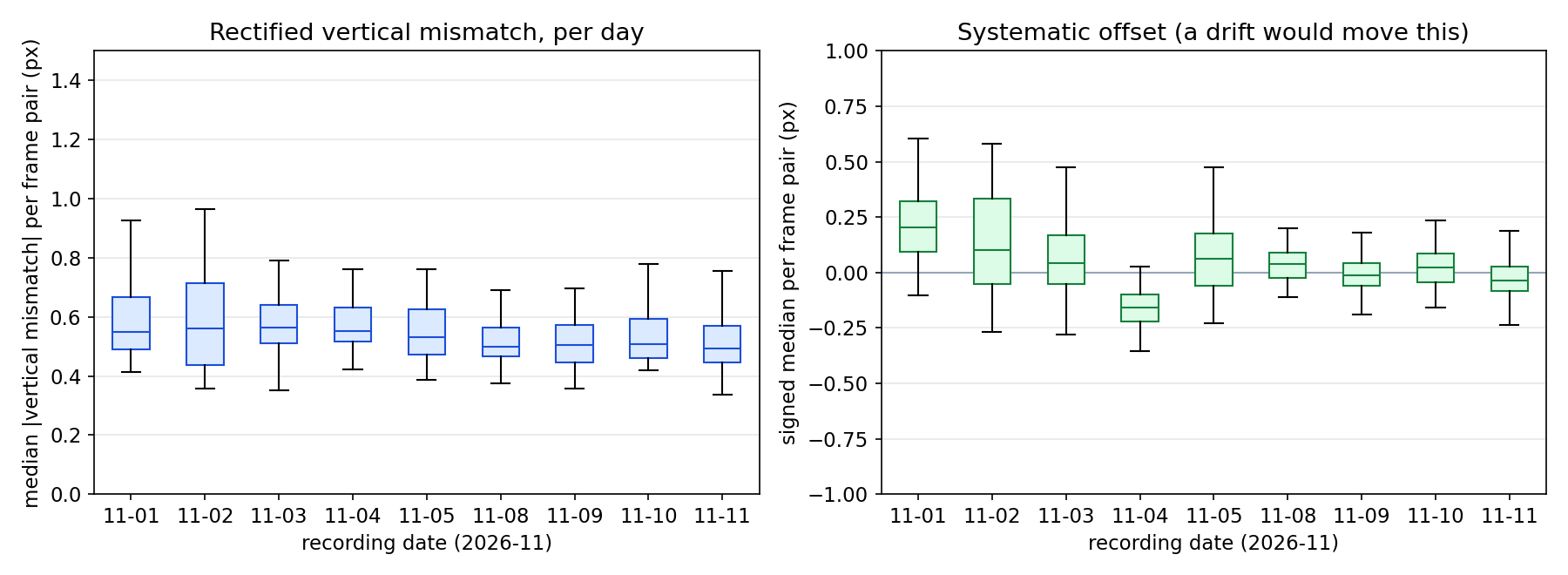
| Date (2026) | Frame pairs | Matched points | Signed offset (px) | Median |mismatch| (px) | Rotation re-estimated vs factory | Left/right exposure gap (median) |
|---|---|---|---|---|---|---|
| 11-01 | 60 | 32,782 | +0.20 | 0.55 | 0.14° | 15 µs |
| 11-02 | 60 | 35,842 | +0.10 | 0.56 | 0.02° | 15 µs |
| 11-03 | 60 | 31,055 | +0.04 | 0.56 | 0.15° | 15 µs |
| 11-04 | 36 | 22,990 | −0.16 | 0.55 | 0.06° | 15 µs |
| 11-05 | 60 | 31,272 | +0.06 | 0.53 | 0.06° | 15 µs |
| 11-08 | 60 | 36,434 | +0.04 | 0.50 | 0.07° | 15 µs |
| 11-09 | 60 | 42,567 | −0.01 | 0.51 | 0.05° | 15 µs |
| 11-10 | 60 | 30,788 | +0.02 | 0.51 | 0.08° | 14 µs |
| 11-11 | 60 | 35,328 | −0.03 | 0.49 | 0.18° | 15 µs |
Finding 2
The test would catch a 0.05° change
A flat result is only convincing if the test could have seen a change. We took the 18,263 matched points of 2026-11-08 and rectified them with the factory calibration tilted on purpose. A tilt of 0.05° between the eyes raised the median mismatch to 0.61 px, above every measured day; 0.1° gave 0.82 px. Using the 800×600 factory file directly on 1600×1200 video, the mistake described in Field Note #20, gave 8.1 px.
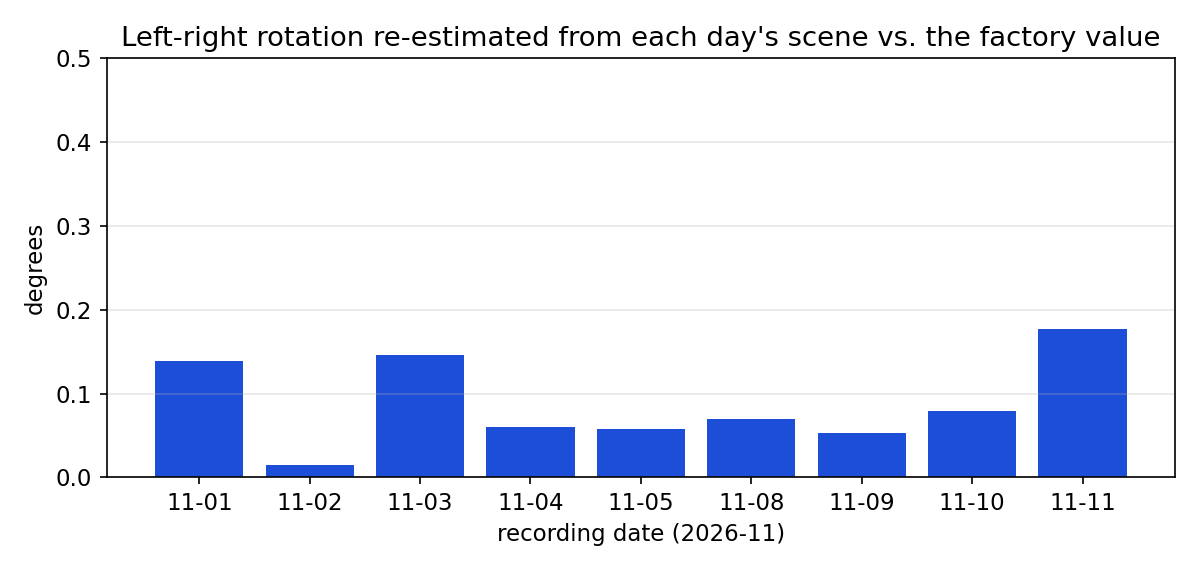
Re-estimating the left-right rotation from each day's scene alone gave 0.02–0.18° from the factory value with no trend; this estimate is noisier than the row test and agrees with it.
| Calibration used | Median |vertical mismatch| |
|---|---|
| Factory file, scaled to the recording resolution | 0.50 px |
| …tilted 0.05° (pitch) | 0.61 px |
| …tilted 0.1° (pitch) | 0.82 px |
| …tilted 0.25° (pitch) | 1.67 px |
| …tilted 0.5° (pitch) | 3.26 px |
| 800×600 file used as-is on 1600×1200 video (Field Note #20) | 8.11 px |
Finding 3
Timing held as well
The same nine recordings also showed the left and right exposure starts 14–15 µs apart (median, 99th percentile ≤ 30 µs) on every day, matching the metadata value checked externally in Field Note #22.
How we use it
A calibration check that runs on every upload
The row test needs no target, no extra recording and no operator time: it runs on frames the rig records anyway. We run it per recording on the server and keep the result with the data.
- Every delivery includes the daily mismatch value next to the calibration file it was computed with.
- If a day leaves the band (for example after a drop), that recording is flagged and the rig is recalibrated before further use.
- The same test catches a wrong or wrong-resolution calibration file immediately (8 px instead of 0.5 px).
What this means
One factory calibration, nine working days, no measurable drift
Verified: over 11 days of daily head-mounted work, the factory calibration of this rig kept left and right matches within the same half-pixel band each day, with no trend; a change of 0.05° or more between the eyes would have been visible.
For buyers: ask any stereo data vendor how they know the calibration is valid on the day of each recording. Ours is measured per recording and delivered with the data.
SCOPE AND LIMITS
Limitations
What this note does not show, stated up front.
- One rig, one site, one wearer; nine 5-minute samples, one per day, not every minute of every day.
- The row test checks rotation between the eyes and the lens models; it is weakly sensitive to a change in baseline length, which was checked separately for depth scale in Field Note #9.
- Features come from the work scene; days with fewer textured surfaces would give fewer matches.
- Preliminary analysis: AI-assisted automated analysis; no third-party review.
FAQ
Questions data buyers ask
Q01How often does a head-mounted stereo rig need recalibration?
Q02How can calibration be checked without a calibration target?
Q03How small a calibration change can this detect?
Q04Did stereo timing stay stable too?
OPEN DATA AND CODE
Reproduce and inspect the evidence
Every number in this note can be checked: derived tables, analysis code, figures and a runnable notebook are public.
 GitHubAnalysis code and reproduction steps
origin-data-lab/factory-stereo-calibration-stability-nine-work-daysView repository  Hugging FaceDataset card, tables and figures
origin-data-lab/factory-stereo-calibration-stability-nine-work-daysOpen dataset  Data explorer and runnable notebook
origindatalab/odl-stereo-calibration-stability-9-daysExplore on Kaggle Licence: CC BY 4.0 (data and figures) · MIT (code)
Origin Data Lab (2026). Technical Field Note #26: Does the factory stereo calibration still hold after 11 days of head-mounted work? https://origindatalab.io/technical-field-notes/factory-stereo-calibration-stability-nine-work-days.html
CONTINUE READING
Related field notes
Want this measured on your data?
Origin Data Lab plans and runs egocentric, stereo+IMU and field video capture with documented QA, for physical AI and robotics teams.