Technical Field Note #28 · November 2026
Usable hours are not usable clips: how many 10-second clips an hour of real work gives
Field Note #28 · Usable clip length for egocentric stereo+IMU capture (ODL-EGO S1), 10 working days
Field Note #27 counted usable seconds over ten working days (20.6 hours). Robot-learning buyers usually need continuous clips, so here we measured how those seconds join up. On the five bare-hand days, 51.9% of seconds were usable, but the median unbroken usable stretch was 2 seconds. Counted strictly, an hour of recording held 42 usable clips of at least 10 seconds and 1.8 of at least 30 seconds; only 19% of recorded time sat inside a 10-second-plus clip. Most breaks were single seconds: of the isolated one-second gaps inside usable stretches, about half failed only the hand check, and in 24 of those checked by eye the hand was still visible in 22. Allowing one failed second inside a clip raised the yield to 66 ten-second clips per hour and 37% of recorded time. On glove days the same counts were 8.5 and 16.4. Delivery quotes should therefore state clip length and gap tolerance, not only usable hours.
Why this matters
Buyers train on clips, not on seconds
A usable-hours figure counts seconds wherever they fall. A manipulation policy is trained on continuous clips: a grasp, a pour, a tie, usually several seconds long. Fifty percent usable seconds scattered in one-second pieces is worth far less than the same share in long runs.
Field Note #27 gave per-second results for ten working days. This note asks the buyer's next question: how many clips of a given length does one recorded hour produce?
Setup
Same per-second index, joined into runs
Data: the Field Note #27 index, one row per second for 20.6 hours (74,044 s) of head-mounted produce-portioning work, 2026-11-01 to 11-12, one R8 stereo+IMU rig (ODL-EGO S1). Five days in work gloves, five bare-handed.
A second is usable when exposure is OK, camera blur ≤ 8 px, the wearer looks at least 30° down and a hand is found (as in Field Notes #25 and #27). Consecutive usable seconds within a recording form a run; consecutive 5-minute files of one session are joined. "Strict" ends a run at the first failed second; "1-s gap allowed" keeps a run going across one failed second, but not two.
To see why runs break, we took the isolated one-second gaps (usable before and after) and listed which check failed. From the bare-hand gaps that failed only the hand check, 24 were drawn at random and checked by eye.
Finding 1
Half the seconds are usable, but they come in short pieces
On bare-hand days 51.9% of seconds were usable, yet the median unbroken usable stretch was 2 seconds and the 90th percentile 9 seconds. Counted strictly, one recorded hour held 42 clips of at least 10 seconds and 1.8 of at least 30 seconds. Only 19% of recorded time sat inside a clip of 10 seconds or more.
Glove days were far lower at every length (8.5 ten-second clips per hour), because the hand check failed twice as often there (Field Note #27).
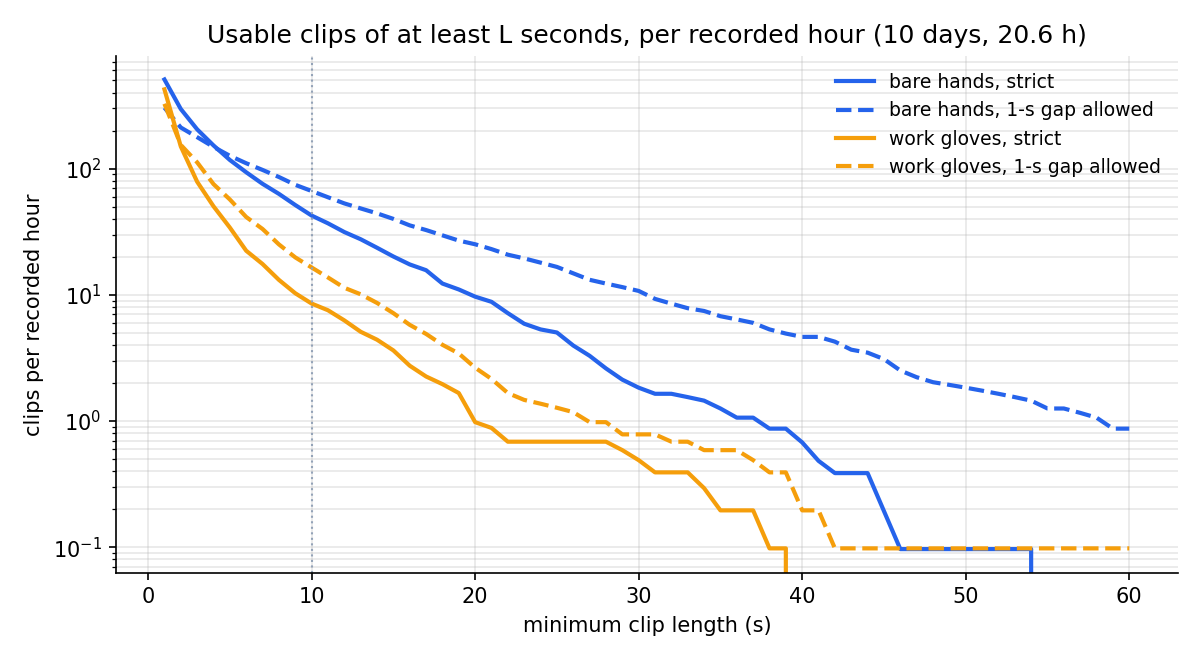
| Bare hands (5 days) | Work gloves (5 days) | |
|---|---|---|
| Usable seconds | 51.9% | 23.7% |
| Median usable stretch, strict | 2 s | 1 s |
| 10-s+ clips per recorded hour, strict | 42.4 | 8.5 |
| 10-s+ clips per hour, 1-s gap allowed | 66.4 | 16.4 |
| 30-s+ clips per hour, strict / 1-s gap | 1.8 / 10.7 | 0.5 / 0.8 |
| Share of recorded time inside 10-s+ clips, strict | 19.2% | 3.6% |
| Same, 1-s gap allowed | 37.1% | 7.1% |
Finding 2
Most breaks are one second long, and many are detector misses
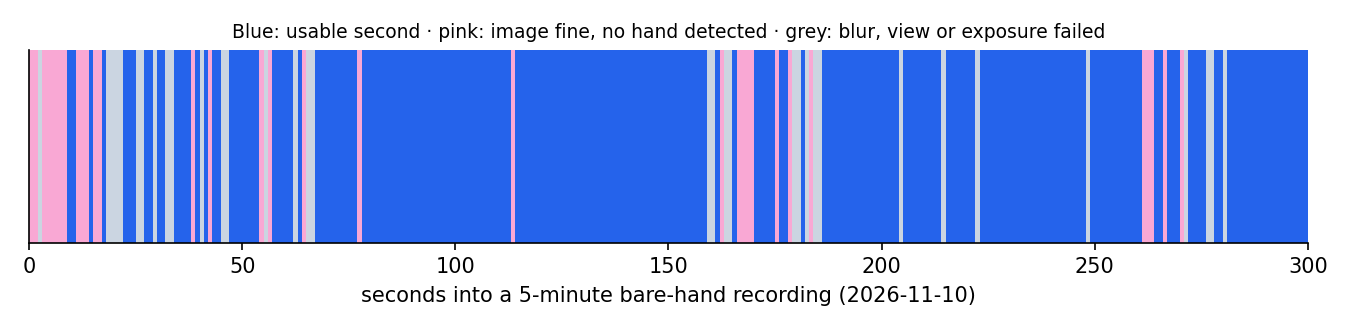
A typical bare-hand recording shows long usable stretches cut by single seconds (figure). Of the isolated one-second gaps on bare-hand days, 52% failed only the hand check and 48% failed the blur check (a quick head turn); exposure and view almost never broke a run.
Checked by eye, the hand was still visible in 22 of 24 randomly chosen hand-only gaps. These breaks come from the detector, not from the work.
Finding 3
Allowing one failed second changes the yield by half
Keeping a clip going across a single failed second raised bare-hand yield from 42 to 66 ten-second clips per hour, from 1.8 to 10.7 thirty-second clips, and the share of recorded time inside 10-second-plus clips from 19% to 37%. Every bare-hand day stayed in a narrow band: 34–49 clips per hour strict and 62–74 with the gap allowed.
Whether a one-second gap is acceptable depends on the buyer: a detector miss with the hand in view is usually harmless; a blur spike may not be.
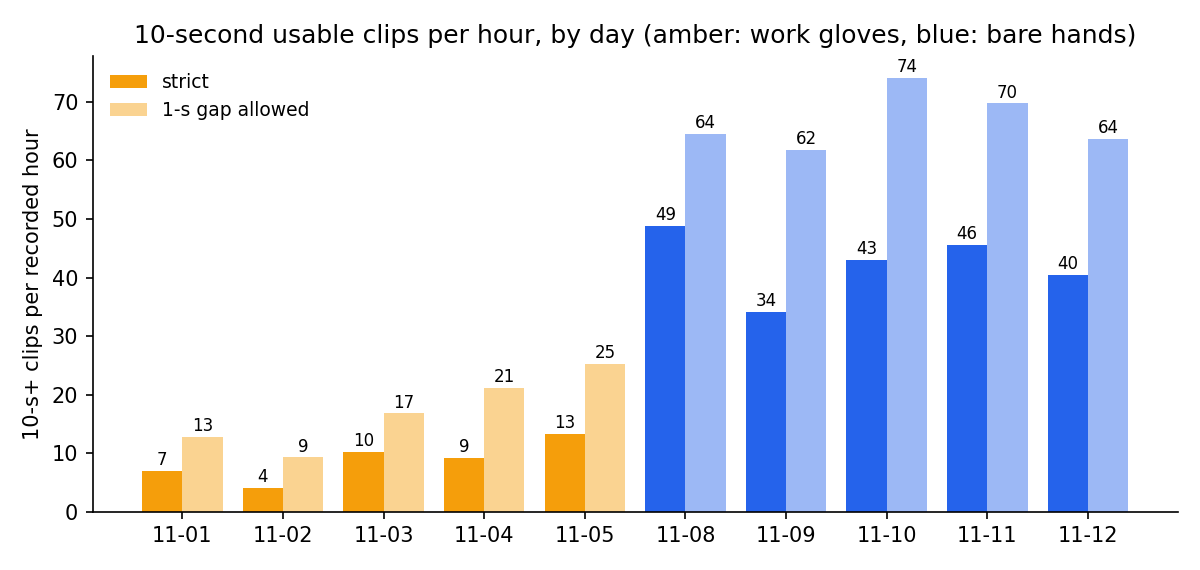
| Date | Hands | 10-s+ clips/h, strict | 10-s+ clips/h, 1-s gap allowed |
|---|---|---|---|
| 11-01 | gloves | 7.0 | 12.8 |
| 11-02 | gloves | 4.1 | 9.3 |
| 11-03 | gloves | 10.3 | 16.8 |
| 11-04 | gloves | 9.2 | 21.1 |
| 11-05 | gloves | 13.3 | 25.2 |
| 11-08 | bare | 48.8 | 64.5 |
| 11-09 | bare | 34.1 | 61.8 |
| 11-10 | bare | 43.0 | 74.1 |
| 11-11 | bare | 45.5 | 69.7 |
| 11-12 | bare | 40.5 | 63.7 |
What we changed
Clip yield is now part of every quote
Usable time is now reported together with clip yield:
- Each delivery states clips per hour at the buyer's minimum length, with the gap rule used (strict, or one failed second allowed and why it failed).
- Bridged seconds are flagged in the index, so a buyer can drop them or keep them.
- Quotes for robot-learning buyers start from clips of the required length, not from recorded or usable hours.
What this means
Ask for clips at your length
Verified: on bare-hand days at this site, 42 clips of 10 s or more per recorded hour strict, 66 with one failed second allowed; stable from day to day.
Reviewed on a small sample: most single-second breaks with no hand detected still showed the hand.
For buyers: usable hours alone can overstate clip yield by a factor of two or more. Ask for clips per hour at your minimum length and the gap rule behind them.
SCOPE AND LIMITS
Limitations
What this note does not show, stated up front.
- One site, one wearer, one rig; clip yield depends strongly on the task. Produce portioning has many short actions.
- Per-second checks use the keyframe that opens each second (Field Note #27); a run can hide a failed frame inside a passing second.
- The by-eye review covers 24 gaps from bare-hand days only.
- Preliminary analysis: AI-assisted automated analysis plus a small manual review; no third-party review.
FAQ
Questions data buyers ask
Q01How many 10-second usable clips does one hour of egocentric work video give?
Q02Why is clip yield lower than usable time suggests?
Q03What is a 1-second gap tolerance?
OPEN DATA AND CODE
Reproduce and inspect the evidence
Every number in this note can be checked: derived tables, analysis code, figures and a runnable notebook are public.
 GitHubAnalysis code and reproduction steps
origin-data-lab/usable-clip-length-egocentric-work-ten-daysView repository  Hugging FaceDataset card, tables and figures
origin-data-lab/usable-clip-length-egocentric-work-ten-daysOpen dataset  Data explorer and runnable notebook
origindatalab/odl-usable-clip-length-10-work-daysExplore on Kaggle Licence: CC BY 4.0 (data and figures) · MIT (code)
Origin Data Lab (2026). Technical Field Note #28: Usable hours are not usable clips. https://origindatalab.io/technical-field-notes/usable-clip-length-egocentric-work-ten-days.html
CONTINUE READING
Related field notes
Want this measured on your data?
Origin Data Lab plans and runs egocentric, stereo+IMU and field video capture with documented QA, for physical AI and robotics teams.