Technical Field Note #16 · November 2026
Does the data hold up over a real shift? Recording integrity and calibration over 2 h 25 min of head-mounted work
Field Note #16 · Long-session integrity and calibration stability, head-mounted stereo+IMU rig (ODL-EGO S1)
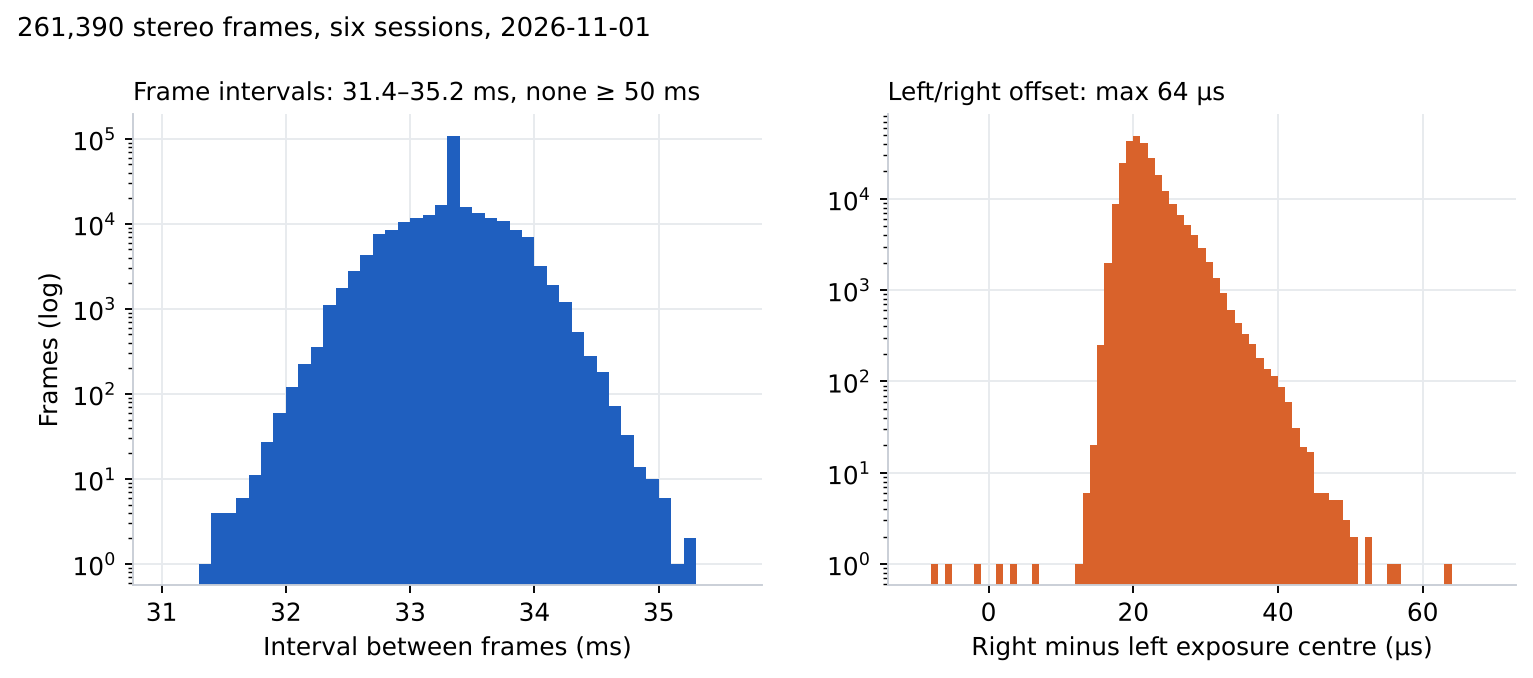
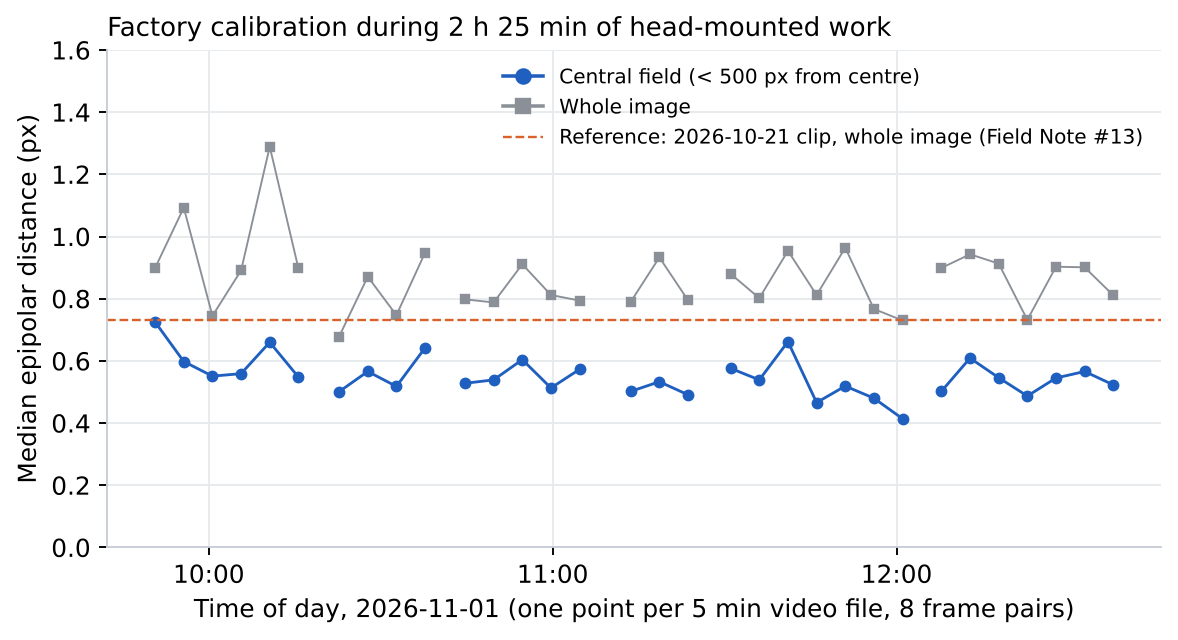
Short test recordings rarely show the failures that matter in production: dropped frames late in a session, gaps at file boundaries, IMU buffer overruns, or a calibration that drifts once the rig warms up and is worn on a moving head. We checked all of these on 2.4 hours of real produce-portioning work recorded as six sessions and 32 five-minute video files. Every one of the 261,390 left/right frame pairs was present, with consecutive strobe counters, a left/right exposure offset of at most 64 µs, and no gaps at any of the 26 file boundaries. The 500 Hz IMU recorded 4,370,281 gyro samples with no sequence breaks and a largest gap of 2.2 ms. A target-free epipolar check on 138,940 feature matches showed no drift: the central-field median stayed between 0.41 and 0.72 px in every file. Metric scale was not re-checked.
Why this matters
Buyers receive hours, not minutes
A dataset is delivered in hours of continuous work. Problems that never show in a five-minute test, such as frame drops when the storage card fills, gaps where the recorder splits files, IMU buffers overflowing, or a calibration that shifts with heat and head movement, show up only in long real sessions.
This note checks a full morning of real work end to end, using only data the rig already records: per-frame exposure timestamps, strobe counters, the IMU stream, the device log, and the images themselves for calibration.
Setup
Six sessions, 32 video files, one morning of real work
Recording: 2026-11-01, 09:48–12:37, produce portioning for school meals in a food supplier's workroom, rig worn on the head. Six sessions of 14–32 minutes; the recorder splits each session into 5-minute files (32 files per eye). One IMU file covers each session.
Inputs: per-frame exposure start and duration with a strobe counter (embedded in each video), the IMU stream, the device recording log, and 8 left/right frame pairs sampled from every 5-minute file for the calibration check.
Frames and sync
All 261,390 frame pairs present, left/right within 64 µs
No frame was missing in either eye: interval-based counting found zero drops, the strobe counters advanced by exactly one at every frame, left and right had identical frame counts in every file, and the device log reported all frames written with zero strobe drops (five of six sessions; see limits).
Left and right exposures were offset by a median of 21 µs and never more than 64 µs, under 0.2% of a frame period. The interval between exposure centres ranged from 31.4 to 35.2 ms; the spread around 33.3 ms comes from frame-to-frame exposure changes, not from missing or late frames.
File boundaries were seamless: at all 26 boundaries the next frame followed after 32.6–34.1 ms with the strobe counter advancing by one.
| Session start | Minutes | Video files | Frames (L = R) | Dropped frames | L/R offset, max (µs) | IMU samples | IMU max gap (ms) |
|---|---|---|---|---|---|---|---|
| 09:48 | 27.5 | 6 | 49,473 | 0 | 52 | 827,241 | 2.11 |
| 10:20 | 17.9 | 4 | 32,225 | 0 | 55 | 538,782 | 2.11 |
| 10:42 | 21.7 | 5 | 38,998 | 0 | 64 | 652,005 | 2.11 |
| 11:11 | 14.1 | 3 | 25,334 | 0 | 49 | 423,551 | 2.19 |
| 11:28 | 32.2 | 7 | 58,015 | 0 | 49 | 969,953 | 2.11 |
| 12:05 | 31.9 | 7 | 57,345 | 0 | 51 | 958,749 | 2.11 |
| Total | 145.2 | 32 | 261,390 | 0 | 64 | 4,370,281 | 2.19 |
IMU
No gaps, no sequence breaks
The IMU delivered 4,370,281 gyro and the same number of accelerometer samples at 501.5–501.8 Hz. The largest gap between samples was 2.19 ms (about one sample period), there were no gaps over 5 ms and no sequence-counter breaks, and every video started 2.8–3.6 ms after its IMU stream and ended before it.
Calibration
The factory calibration did not drift during work
For each 5-minute file, SIFT matches on 8 left/right pairs were tested against the factory calibration (138,940 matches after a loose, calibration-free outlier filter). The central-field median stayed between 0.41 and 0.72 px and the whole-image median between 0.68 and 1.29 px, close to the 0.73 px measured on a separate clip eleven days earlier (Field Note #13).
There is no upward trend over the morning (Spearman ρ = -0.37 between file order and central median; the first file is the highest). Head-mounted work, warm-up and two hours of wear did not move the stereo geometry measurably.
Limit: this check detects changes in rotation and intrinsics, not in baseline length, so metric depth scale was not re-checked. A ChArUco board appeared in only one sampled frame, too few for a scale test.
| Session start | Matches | Median, whole image (px) | Median, central field (px) | Matches < 1 px |
|---|---|---|---|---|
| 09:48 | 22,184 | 0.91 | 0.60 | 53% |
| 10:20 | 17,177 | 0.79 | 0.54 | 57% |
| 10:42 | 20,991 | 0.81 | 0.55 | 56% |
| 11:11 | 13,707 | 0.82 | 0.50 | 55% |
| 11:28 | 32,617 | 0.83 | 0.51 | 55% |
| 12:05 | 32,264 | 0.86 | 0.53 | 54% |
| All | 138,940 | 0.84 | 0.54 | 55% |
What we changed
Checks that run on every delivery
Verified: frame completeness, stereo sync, file-boundary continuity, IMU continuity and calibration consistency for this morning of real work.
Process: these checks are now one QA tool (included as analysis/qa/odl_delivery_qa.py and tested on this recording). From the next delivery on, every delivery ships with its QA report: dropped frames, maximum left/right offset, IMU gaps and the per-file epipolar median. We also stop the recorder before powering off so the device writes its closing log entry.
- Report dropped frames, max L/R offset, IMU max gap and per-file epipolar median with every delivery.
- Recheck metric scale with a board at the start or end of each capture day.
- Stop recording before power-off.
SCOPE AND LIMITS
Limitations
What this note does not show, stated up front.
- One rig, one worker, one morning (2026-11-01), one workroom; not a population estimate.
- All checks are automated: AI/algorithm-only preliminary analysis; no human re-verification.
- Calibration was checked on 8 frame pairs per 5-minute file; the epipolar test does not detect changes in baseline length (metric scale).
- The last session's device log has no closing entry (the recorder was likely powered off before stopping); its video and IMU data were complete up to the end.
- The device log reports an IMU 'drop' counter roughly equal to the samples written in every session, including earlier recordings; its meaning (possibly 2:1 decimation of an internal rate) is not confirmed by the supplier, and the written stream itself has no gaps.
- Raw video is not published (other workers and a private workroom are visible); only per-frame numeric data are included.
FAQ
Questions data buyers ask
Q01Does the stereo+IMU rig drop frames in long recordings?
Q02How well synchronised are the left and right cameras?
Q03Does the calibration drift when the rig is worn during work?
Q04Is the IMU stream continuous?
Q05How was this checked without a calibration target?
OPEN DATA AND CODE
Reproduce and inspect the evidence
Every number in this note can be checked: derived tables, analysis code, figures and a runnable notebook are public.
 GitHubAnalysis code and reproduction steps
origin-data-lab/real-work-session-recording-integrity-calibration-holdupView repository  Hugging FaceDataset card, tables and figures
origin-data-lab/real-work-session-recording-integrity-calibration-holdupOpen dataset  Data explorer and runnable notebook
origindatalab/odl-long-session-stereo-integrityExplore on Kaggle Licence: CC BY 4.0 (data and figures) · MIT (code)
Origin Data Lab (2026). Technical Field Note #16: Recording integrity and calibration over 2 h 25 min of head-mounted work. https://origindatalab.io/technical-field-notes/real-work-session-recording-integrity-calibration-holdup.html
Need real-world data measured to this standard?
Origin Data Lab plans and runs egocentric, stereo+IMU and field video capture with documented QA, for physical AI and robotics teams.