Technical Field Note #15 · November 2026
How much does head motion blur egocentric video? Measured over 2 h 25 min of real work
Field Note #15 · Head motion and motion-blur budget from IMU and per-frame exposure (ODL-EGO S1 capture rig)
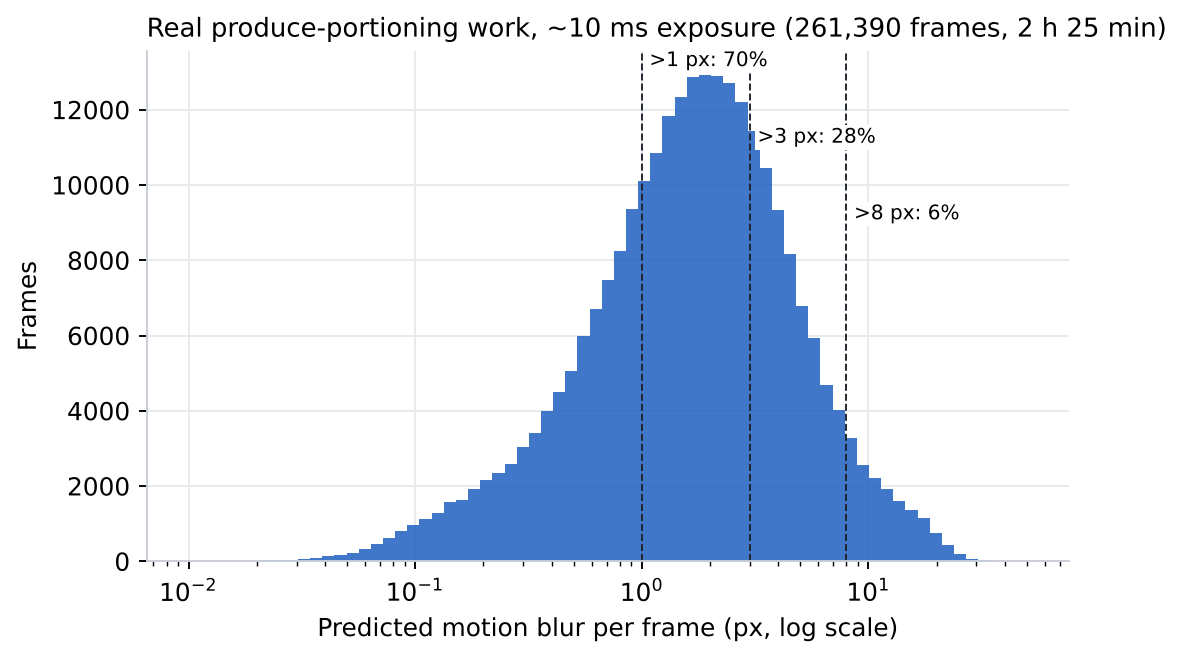
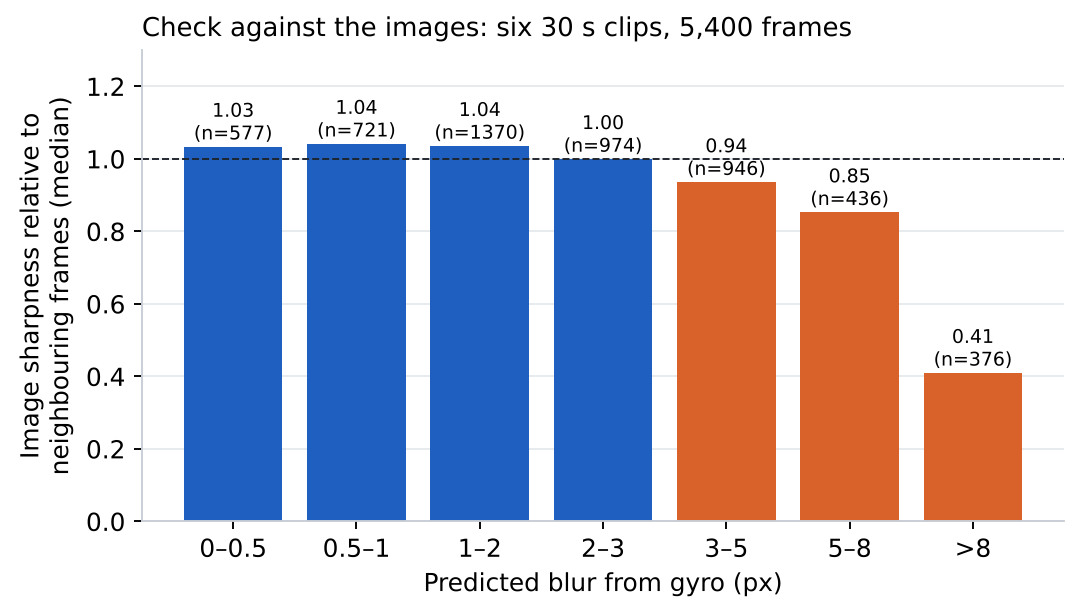
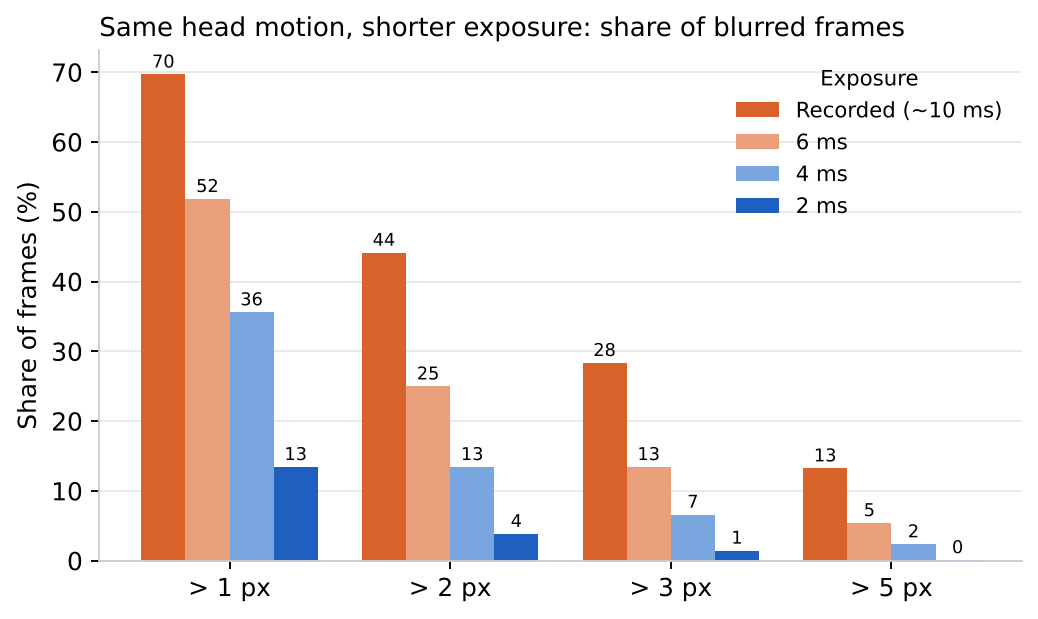
Motion blur is the most common quality complaint about egocentric video, yet it is rarely measured. Our rig records the exposure window of every frame and a 500 Hz gyroscope on the same clock, so the camera rotation during each exposure can be computed exactly. Over 2.4 hours of real produce-portioning work (six sessions, 261,390 frames), head rotation had a median speed of 22 °/s and a 95th percentile of 112 °/s. At the recorded ~10 ms exposure, the median frame carried 1.7 px of camera-induced blur; 70% of frames exceeded 1 px, 28% exceeded 3 px and 6% exceeded 8 px. Image sharpness in 5,400 clip frames confirms the prediction: no measurable loss below 3 px, 15% loss at 5–8 px and 59% above 8 px. The same motion at 4 ms would leave 7% of frames above 3 px. From our next delivery on, every session ships with a per-frame blur estimate.
Why this matters
Blur is a data-quality problem buyers notice first
In head-mounted video, the camera turns whenever the worker looks at the next item. Every turn during an exposure smears the image, which weakens hand and object detail, feature tracking and stereo matching.
Blur is usually judged by eye from a few clips. This note measures it for every frame of a real session, from sensors already in the recording, and checks the measurement against the images.
Setup
2.4 hours of real produce portioning, recorded as normal work
Work: weighing, bagging and labelling vegetables for school-meal deliveries in a food supplier's workroom on 2026-11-01. The worker wore the stereo+IMU rig on the head; the session was recorded in six blocks of 14–32 minutes (261,390 frames per eye) with no instructions to move differently.
Data used: the per-frame exposure start and duration embedded in the video stream, and the 500 Hz gyroscope on the same clock (Field Note #10 measured the alignment). The gyro is rotated into the camera frame with the factory camera–IMU rotation.
Blur model: rotation integrated over each exposure window; pitch and yaw blur at the image centre = 482 px/rad × rotation angle; roll blur evaluated at 400 px from the centre; the two combined. This is camera-induced blur only: the motion of the hands themselves is not included.
Result
28% of frames carry more than 3 px of blur at ~10 ms
The recorded exposure was 10.0 ms in the median frame (5th–95th percentile 8.9–10.6 ms, maximum 12.1 ms). Head speed had a median of 22 °/s, a 95th percentile of 112 °/s and a maximum of 460 °/s.
The resulting blur has a median of 1.73 px, a 90th percentile of 5.9 px and a 99th percentile of 16.5 px. All six sessions look alike: 25–30% of frames above 3 px in each, so this is a property of the task and the exposure, not of one session.
| Session start | Minutes | Head speed, median (°/s) | Head speed, 95th pct (°/s) | Frames > 1 px | Frames > 3 px |
|---|---|---|---|---|---|
| 09:48 | 27.5 | 19 | 103 | 66% | 25% |
| 10:20 | 17.9 | 23 | 125 | 70% | 30% |
| 10:42 | 21.7 | 23 | 114 | 70% | 28% |
| 11:11 | 14.1 | 20 | 102 | 64% | 25% |
| 11:28 | 32.2 | 24 | 113 | 71% | 30% |
| 12:05 | 31.9 | 24 | 116 | 73% | 30% |
Check
Does the gyro prediction match the images?
In six 30 s clips (5,400 frames) we measured image sharpness (variance of the Laplacian in the central 800×600 region) and divided it by the median of the 31 surrounding frames to remove scene changes. Sharpness falls as predicted blur rises (Spearman ρ = -0.41 pooled, -0.52 to -0.33 per clip).
Below 3 px there is no measurable loss, likely because video compression already limits fine detail at this bitrate. Frames at 3–5 px keep 94% of their neighbours' sharpness, 5–8 px 85% and above 8 px only 41%. For this rig, 3 px is therefore the practical threshold and 8 px marks severe blur.
Budget
What a shorter exposure would buy
Blur scales with exposure time for the same motion. Scaling the measured rotations, frames above 3 px would fall from 28% to 13% at 6 ms, 6.6% at 4 ms and 1.4% at 2 ms.
The cost is light: at 4 ms the sensor needs 2.5× more light or gain, which adds noise in a typical indoor workroom. We did not test shorter exposures here; this is the budget for deciding whether to.
| Threshold | Recorded (~10 ms) | If 6 ms | If 4 ms | If 2 ms |
|---|---|---|---|---|
| > 1 px | 69.7% | 51.8% | 35.6% | 13.4% |
| > 2 px | 44.1% | 25.0% | 13.4% | 3.8% |
| > 3 px | 28.3% | 13.4% | 6.6% | 1.4% |
| > 5 px | 13.2% | 5.4% | 2.4% | 0.1% |
What we changed
A per-frame blur score with every delivery
Verified: head-motion statistics and the camera-induced blur of every frame for this task and rig, and the agreement of that estimate with image sharpness.
Process change: the calculation is now part of our delivery QA tool (included in this package as analysis/qa/odl_delivery_qa.py and tested on this recording). From the next delivery on, each session ships with a per-frame blur file (chunk, frame, exposure, head speed, blur in px), so a buyer can filter or weight frames without running an image model. Next, we will test a capped exposure under the same workroom lighting.
- Treat 3 px as the practical blur threshold for this rig and bitrate; 8 px as severe.
- Expect about a quarter of frames above 3 px for active hand work at ~10 ms.
- Use the per-frame blur score rather than discarding whole clips.
SCOPE AND LIMITS
Limitations
What this note does not show, stated up front.
- One rig, one worker, one task (produce portioning) in one workroom on one day (2026-11-01); other tasks and people will move differently.
- All measurements are automated. No human rating of blur was performed: AI/algorithm-only preliminary analysis.
- Blur model covers camera rotation only; camera translation and hand or object motion are not included. Roll blur is evaluated at a single radius (400 px).
- The sharpness check uses six 30 s clips (one per session) and a relative sharpness measure that also responds to focus and scene changes.
- Shorter-exposure results are scaled from measured motion; noise, gain and lighting effects were not tested.
- Raw video is not published (it shows other workers and a private workroom); only per-frame numeric data are included.
FAQ
Questions data buyers ask
Q01How blurry is head-mounted egocentric video during real work?
Q02Can motion blur be measured without looking at the images?
Q03How fast do heads turn during manual work?
Q04Would a shorter exposure help?
Q05Does this include blur from moving hands?
OPEN DATA AND CODE
Reproduce and inspect the evidence
Every number in this note can be checked: derived tables, analysis code, figures and a runnable notebook are public.
 GitHubAnalysis code and reproduction steps
origin-data-lab/egocentric-head-motion-blur-budget-real-workView repository  Hugging FaceDataset card, tables and figures
origin-data-lab/egocentric-head-motion-blur-budget-real-workOpen dataset  Data explorer and runnable notebook
origindatalab/odl-egocentric-head-motion-blurExplore on Kaggle Licence: CC BY 4.0 (data and figures) · MIT (code)
Origin Data Lab (2026). Technical Field Note #15: How much does head motion blur egocentric video? https://origindatalab.io/technical-field-notes/egocentric-head-motion-blur-budget-real-work.html
CONTINUE READING
Related field notes
Need real-world data measured to this standard?
Origin Data Lab plans and runs egocentric, stereo+IMU and field video capture with documented QA, for physical AI and robotics teams.