Technical Field Note #30 · November 2026
Bare hands, cotton gloves, black nitrile: a standard hand detector finds 88%, 50% and 4% of visible hands
Field Note #30 · Hand covering and usable time for egocentric stereo+IMU capture (ODL-EGO S1), 15 working days
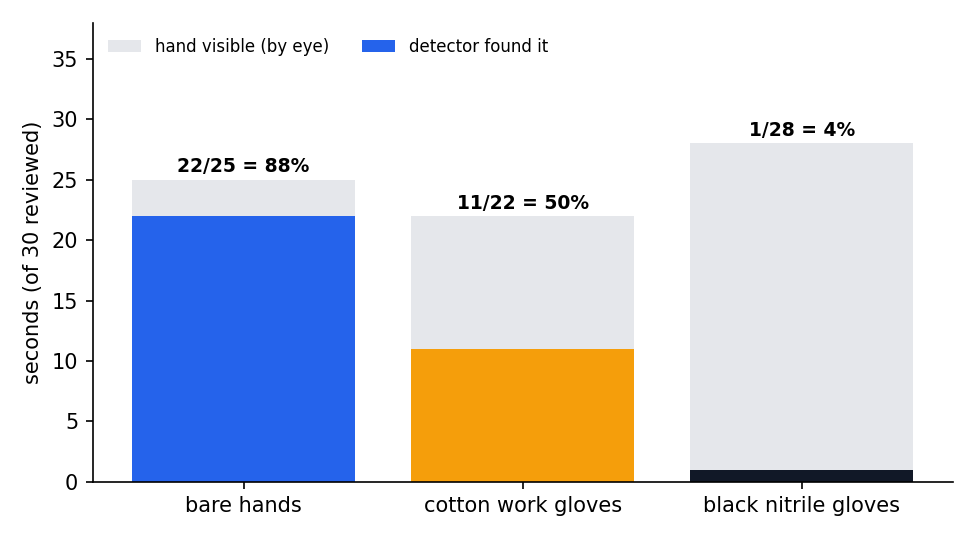
Field Note #27 found that cotton work gloves halved usable time because a standard hand detector missed gloved hands. We then recorded five more working days of the same produce-portioning task, same wearer and rig, in black nitrile gloves, the kind used in most food and assembly work, and ran the same per-second checks over all 15 days (31.8 hours). Image quality barely moved: 74.5% of nitrile seconds passed exposure, blur and view checks against 81.1% bare-handed and 76.0% in cotton gloves. The detector did: it found a hand in 10.8% of nitrile seconds, against 62.2% bare and 29.1% in cotton gloves, so only 8.8% of nitrile time (1.0 of 11.2 hours) passed as usable for manipulation. Checked by eye on 30 random image-usable seconds per condition, the hands were visible in 28 of 30 nitrile seconds and the detector found 1 of those 28 (4%), against 88% bare and 50% in cotton gloves. Lowering the confidence threshold, cropping to the work area or boosting contrast found at most 3 of 28. A detector-based filter would have discarded about nine-tenths of perfectly usable gloved footage.
Why this matters
Most real workplaces are gloved
Food processing, assembly, logistics and labs mostly work in disposable nitrile gloves, often black or blue. Egocentric data for robot learning is valuable precisely because it comes from such workplaces.
Many pipelines keep only the seconds in which an off-the-shelf hand detector fires. Field Note #27 showed that cotton work gloves halved what that filter keeps. This note adds the glove that real sites actually use.
Setup
Same task, same wearer, same rig, three hand coverings
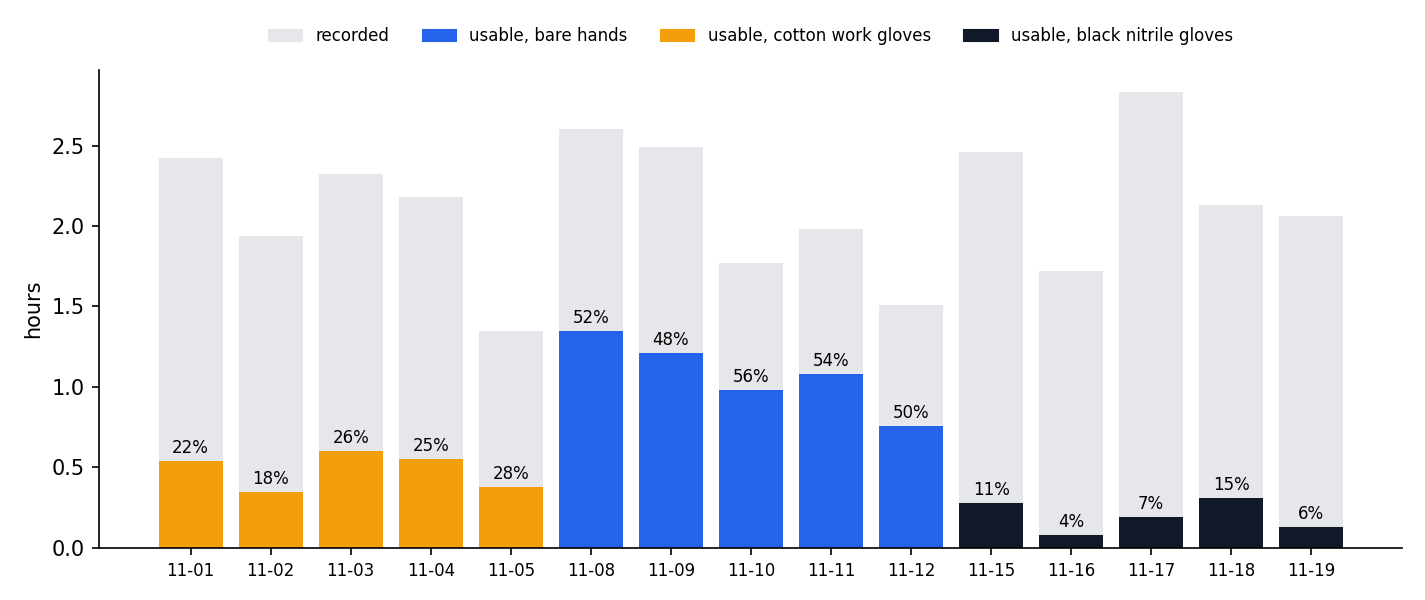
Data: 15 working days of produce portioning for school meals, 2026-11-01 to 11-19, one R8 stereo+IMU rig (ODL-EGO S1) on the wearer's head, 31.8 hours (114,369 seconds). Five days in cotton work gloves with red rubber palms (11-01 to 11-05), five bare-handed (11-08 to 11-12), five in black nitrile gloves (11-15 to 11-19). The nitrile days add 40,325 seconds in 22 sessions.
Per second, as in Field Notes #25 and #27: exposure, camera blur (90th percentile from the gyroscope and exposure time, ≤ 8 px), view direction (at least 30° down) and hands (MediaPipe Hands on the full frame and on the lower work region). A second is usable for manipulation when all four pass.
Check: 30 random image-usable seconds from the nitrile days were viewed and marked for whether the wearer's hand was visible, as was done for the other two conditions in Field Note #27. The 28 nitrile seconds with a visible hand were then re-run through five common detector adjustments.
Finding 1
The pictures are fine; the hand check collapses
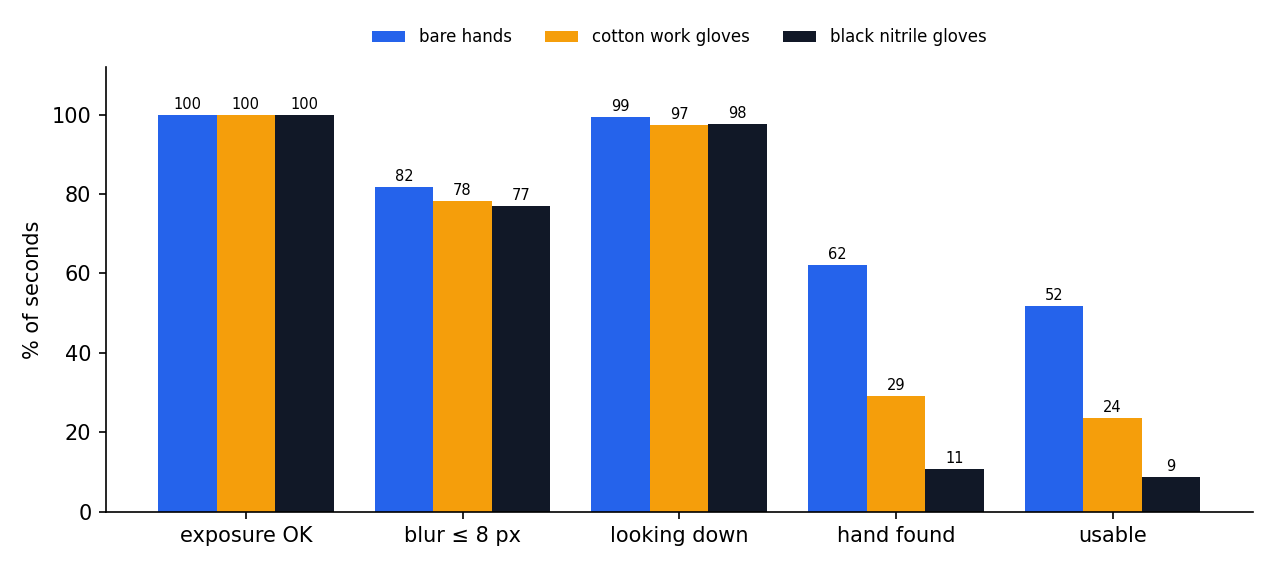
Exposure, blur and view direction were nearly the same in all three conditions: 74.5–81.1% of seconds passed all image checks. The hand check was not: the detector found a hand in 62.2% of bare-hand seconds, 29.1% in cotton gloves and 10.8% in black nitrile. Usable time followed: 51.9%, 23.7% and 8.8%.
Every nitrile day was low (4.4–14.7% usable); every bare-hand day was 48.5–55.5%. Of 11.2 nitrile hours, 1.0 passed the filter.
| Bare hands | Cotton work gloves | Black nitrile gloves | |
|---|---|---|---|
| Days | 11-08 to 11-12 | 11-01 to 11-05 | 11-15 to 11-19 |
| Recorded | 10.35 h | 10.22 h | 11.20 h |
| Exposure OK | 99.9% | 99.9% | 99.8% |
| Camera blur ≤ 8 px | 81.8% | 78.3% | 77.0% |
| Looking down at the work | 99.3% | 97.3% | 97.5% |
| Image checks all passed | 81.1% | 76.0% | 74.5% |
| Hand found by the detector | 62.2% | 29.1% | 10.8% |
| Usable for manipulation | 51.9% (5.38 h) | 23.7% (2.42 h) | 8.8% (0.99 h) |
| Visible hands found (by eye, 30 s each) | 22/25 = 88% | 11/22 = 50% | 1/28 = 4% |
Finding 2
Hands were in view; the detector did not see them
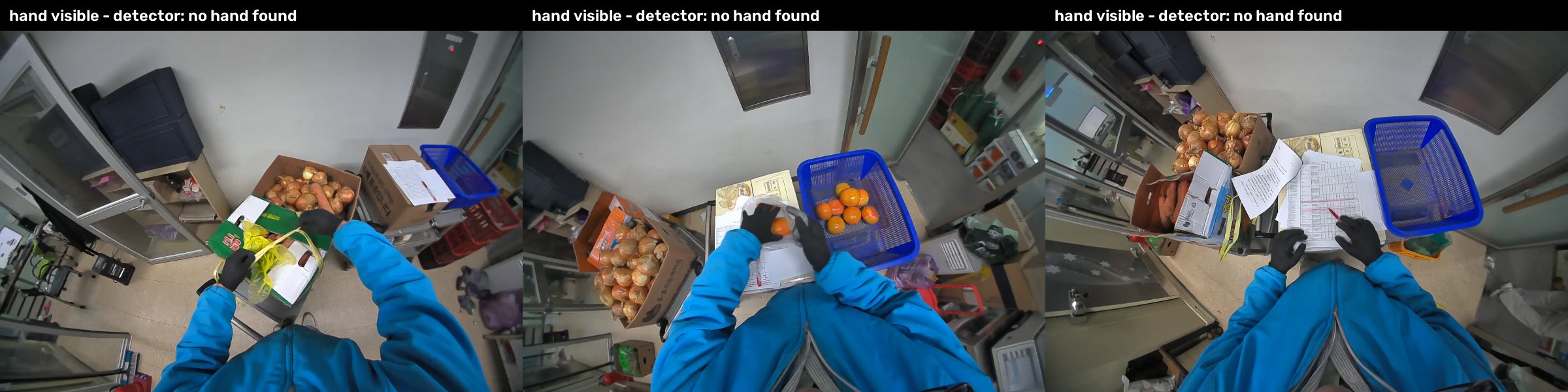
In 30 random image-usable nitrile seconds, the wearer's gloved hand was clearly visible in 28. The detector found it in 1. With the same review, it found 22 of 25 bare hands and 11 of 22 cotton-gloved hands (Field Note #27). There were no false detections in any of the 90 reviewed seconds.
Black nitrile gloves remove skin colour and most of the knuckle and nail detail that a hand model relies on, and the dark glove sits against dark sleeves and shadows. The footage was usable; the filter was blind.
Finding 3
Simple fixes do not rescue it
On the 28 visible-hand nitrile seconds we tried the usual adjustments: cropping to the work area, lowering the confidence threshold to 0.1, contrast equalisation and gamma brightening. The best found 3 of 28. The gap is in what the model has learned, not in how the image is fed to it.
| Detector setting | Visible nitrile hands found |
|---|---|
| Full frame, 800×600, confidence 0.5 (standard) | 1 / 28 |
| Lower work region, 800×500, confidence 0.3 | 1 / 28 |
| Lower work region, confidence 0.1 | 3 / 28 |
| Lower region + CLAHE contrast, confidence 0.3 | 2 / 28 |
| Lower region + gamma 0.5 brightening, confidence 0.3 | 2 / 28 |
| Lower region + gamma 0.4, confidence 0.1 | 2 / 28 |
What we changed
Hand covering is logged; detector filters are calibrated per condition
Every session now records what the worker wears on their hands:
- Hand covering (bare, cotton, nitrile and colour) is a field in the per-second index.
- Detector recall is measured by eye for each covering at each site before any detector-based filter is applied, and reported with the delivery.
- Where recall is low, usable time is counted from image checks plus review, not from the detector, so gloved footage is not thrown away.
- Where a project allows it, we capture bare-handed; where gloves are required, we tell the buyer up front.
What this means
Ask how hand presence was measured, and under which gloves
Verified: over 15 days at one site, usable time under a detector-based filter was 51.9% bare-handed, 23.7% in cotton gloves and 8.8% in black nitrile, while image quality stayed within a few points.
Reviewed on small samples: the detector found 88%, 50% and 4% of visible hands in the three conditions, and simple adjustments did not close the gap.
For buyers and labs: a hand-presence filter tuned on bare hands can silently discard most footage from gloved workplaces. Ask for recall measured on the actual glove, or for usable time that does not depend on the detector.
SCOPE AND LIMITS
Limitations
What this note does not show, stated up front.
- One site, one wearer, one rig; one detector (MediaPipe Hands, default model). Other detectors or glove colours may behave differently.
- Conditions were recorded on different days, not interleaved; small day-to-day differences in task mix are possible. Image checks show the footage itself was comparable.
- By-eye reviews cover 30 seconds per condition; recall figures are indicative.
- Preliminary analysis: AI-assisted automated analysis plus a small manual review; no third-party review.
FAQ
Questions data buyers ask
Q01Do off-the-shelf hand detectors work on black nitrile gloves?
Q02How much usable footage is lost when workers wear gloves?
Q03Does lowering the detector threshold or enhancing contrast fix it?
OPEN DATA AND CODE
Reproduce and inspect the evidence
Every number in this note can be checked: derived tables, analysis code, figures and a runnable notebook are public.
 GitHubAnalysis code and reproduction steps
origin-data-lab/black-nitrile-gloves-hand-detection-usable-time-egocentricView repository  Hugging FaceDataset card, tables and figures
origin-data-lab/black-nitrile-gloves-hand-detection-usable-time-egocentricOpen dataset  Data explorer and runnable notebook
origindatalab/odl-hand-detection-bare-cotton-nitrileExplore on Kaggle Licence: CC BY 4.0 (data and figures) · MIT (code)
Origin Data Lab (2026). Technical Field Note #30: Bare hands, cotton gloves, black nitrile. https://origindatalab.io/technical-field-notes/black-nitrile-gloves-hand-detection-usable-time-egocentric.html
CONTINUE READING
Related field notes
Want this measured on your data?
Origin Data Lab plans and runs egocentric, stereo+IMU and field video capture with documented QA, for physical AI and robotics teams.