Technical Field Note #17 · November 2026
Where does a head-mounted camera point during real work? View direction, hands and self-occlusion over 2 h 25 min
Field Note #17 · Camera view direction, hand position and self-occlusion, head-mounted stereo+IMU rig (ODL-EGO S1)
Head-mounted egocentric data is usually described by hours and resolution, not by where the camera was actually pointing. We measured it for every second of 2 h 25 min of real work, using the gravity direction from the rig's 500 Hz accelerometer. The optical axis was a median 56° below horizontal; 71% of the time it was 45–75° down and only 8% of the time within 30° of level. The IMU-predicted horizon lined up with vanishing points in the images, and the same desk posture at session starts and ends gave 43–48° across four sessions, so the rig did not slide on the head. In sampled frames the hands were visible 83 of 96 times, typically 180 px (21°) below the image centre, well inside the central field, while the wearer's own jacket covered a median 10% of the frame and more as the head tipped down. From the next delivery on, every delivery includes a per-frame view-direction file.
Why this matters
Hours of video say nothing about what is in view
For robot learning from egocentric video, what matters is whether the hands and the objects they touch are in view, how much of the frame is the wearer's own body, and whether the image is upright. These depend on where the camera points, which in turn depends on the task and on how the rig is mounted.
The rig already records the answer: its accelerometer measures gravity in the camera's frame. This note turns that into a per-second view direction for a full morning of real work, checks it against the images, and looks at what it means for hands and self-occlusion.
Setup
8,738 seconds of real work, 256 sampled frames
Recording: 2026-11-01, 09:48–12:37, the same six sessions as Field Notes #15 and #16: produce portioning for school meals in a food supplier's workroom, rig worn on the head, one worker. The worker mostly stood at a bench, with about half an hour of carrying and staging produce at the start.
View direction: gravity from the 500 Hz accelerometer averaged over 1 s windows and rotated into the left camera frame with the factory camera–IMU calibration (a rotation of 0.25°). Pitch is the angle of the optical axis below horizontal; roll is the rotation of the image about that axis.
Images: 256 left frames (8 per 5-minute file). The wearer's blue jacket was segmented by colour (connected regions touching the bottom edge) to measure self-occlusion. In 96 of them (16 per session, evenly spaced) the vertical position of the hands was labelled visually.
Check against the images
The IMU horizon matches the scene, and the rig did not slide
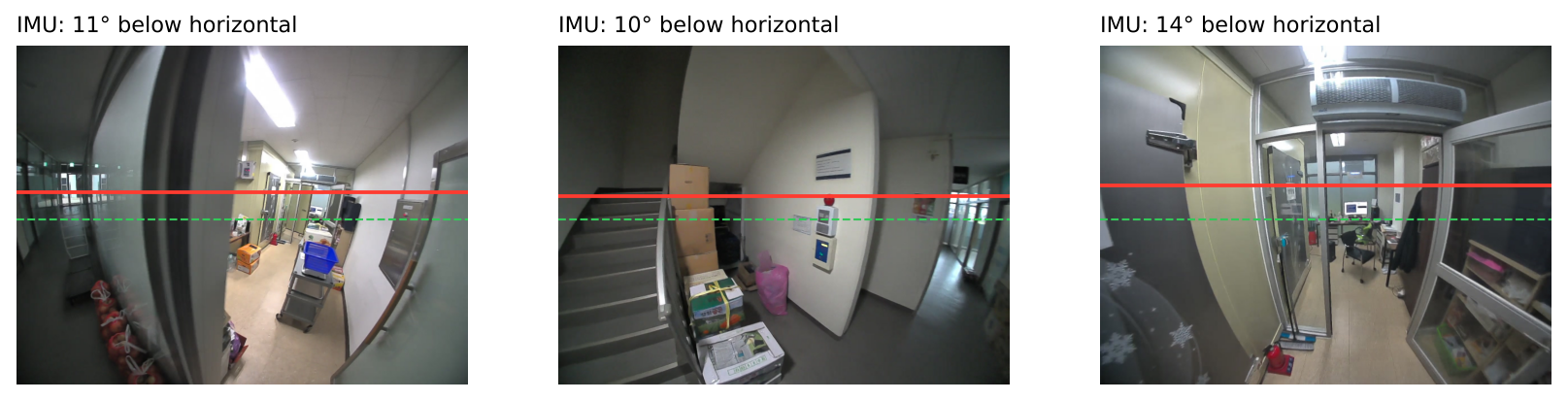
In frames that show a corridor or room with a clear vanishing point, the horizon predicted from the accelerometer alone falls on the vanishing point to within a few pixels, about 1° (three frames checked by eye).
Sessions started and ended at the same desk with the phone in hand (starting or stopping the recording). The 6 sampled frames from these moments, in 4 sessions between 10:42 and 12:37, gave 43.2–47.7° with no trend, so the rig sat at the same angle on the head throughout.
Result
The camera looked 56° down for most of the morning
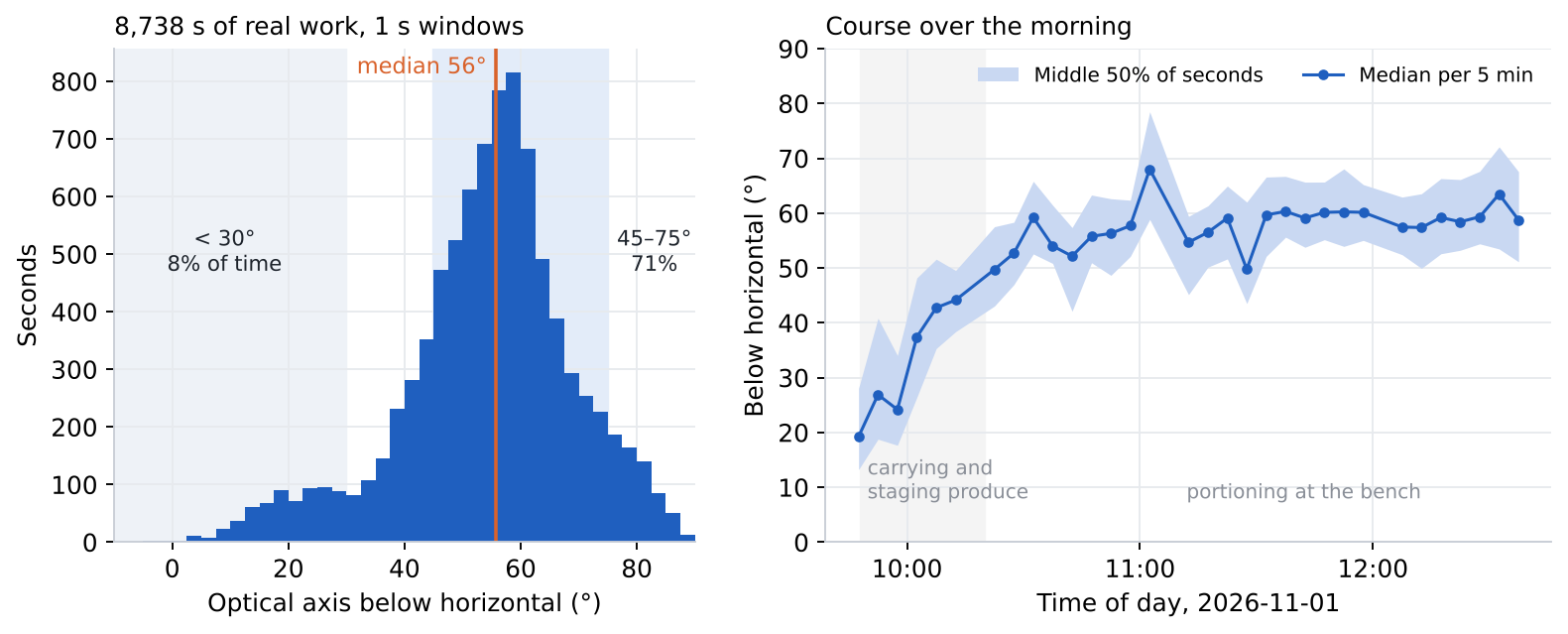
Across all 8,738 seconds the optical axis was a median 56° below horizontal (middle half 47–63°). It was 45–75° down 71% of the time and within 30° of level only 8% of the time.
The first session differs because it was mostly carrying and staging produce (median 37°, 38% of the time under 30°). From 10:20, at the bench, the median was 58°, rising slightly through the morning (about 3° per hour); fatigue and task mix cannot be separated here.
Head turning about the vertical had a median of 19°/s and a 90th percentile of 65°/s.
| Session start | Minutes | Median below horizontal | Middle 50% | Time < 30° | Time 45–75° | Rows tilted > 10° |
|---|---|---|---|---|---|---|
| 09:48 | 27.6 | 37° | 24–47° | 38% | 28% | 40% |
| 10:20 | 17.9 | 54° | 47–61° | 1% | 76% | 38% |
| 10:42 | 21.7 | 57° | 51–64° | 1% | 76% | 47% |
| 11:11 | 14.1 | 56° | 49–62° | 1% | 77% | 57% |
| 11:28 | 32.3 | 60° | 54–66° | 0% | 85% | 65% |
| 12:05 | 31.9 | 59° | 53–67° | 0% | 87% | 59% |
| All | 145.6 | 56° | 47–63° | 8% | 71% | 52% |
Hands and own body
Hands near the centre; 10% of the frame is the wearer
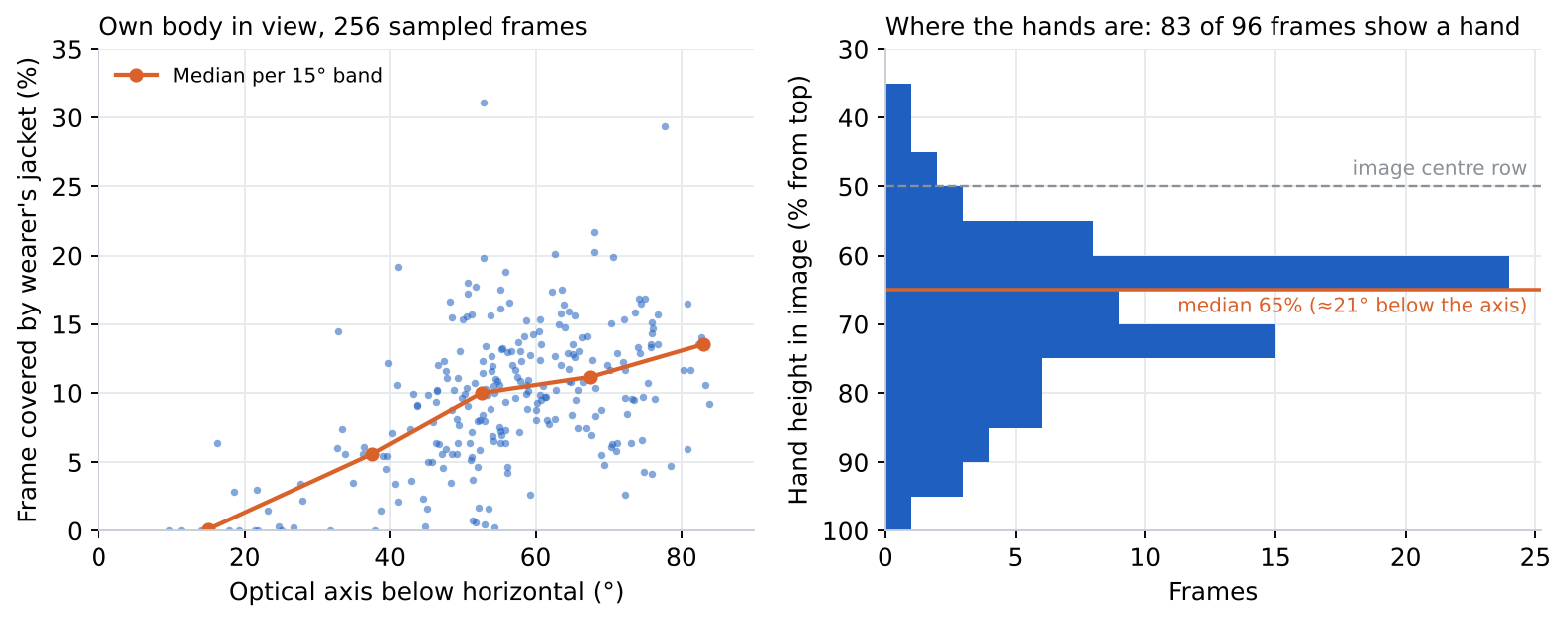
A hand was visible in 83 of 96 labelled frames (78–92%, 95% CI). The hands sat a median 65% of the way down the image (middle half 62–73%), about 180 px or 21° below the optical centre. That is inside the central field used for the calibration check in Field Note #16 (within 500 px of the centre), where the fisheye calibration is tightest.
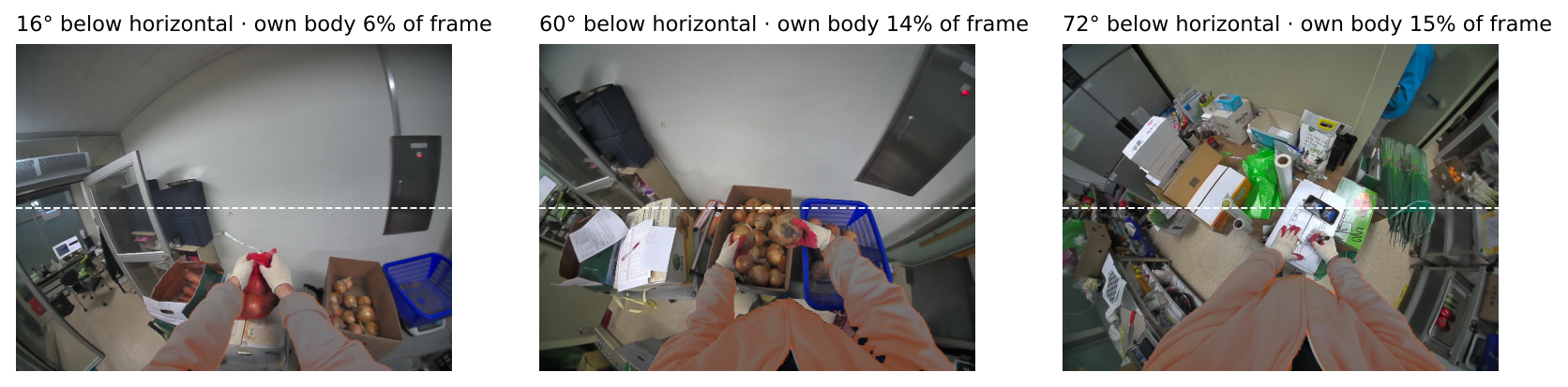
Because the head tips down, the wearer's own jacket, torso and sleeves, is often in view: a median 10% of the frame overall, rising from 0% under 30° to 10% at 45–60°, 11% at 60–75° and 14% beyond 75°.
The image was rarely upright: with the camera less than 70° down, the rows were tilted by more than 10° in 52% of seconds and by more than 20° in 20% (median 10°, mostly to one side).
| Below horizontal | Share of time | Sampled frames | Own body in frame (median) | Hand-labelled frames | Hand visible |
|---|---|---|---|---|---|
| under 30° | 8% | 16 | 0% | 3 | 67% |
| 30-45° | 14% | 26 | 6% | 14 | 86% |
| 45-60° | 45% | 114 | 10% | 44 | 86% |
| 60-75° | 27% | 79 | 11% | 28 | 86% |
| over 75° | 7% | 21 | 14% | 7 | 100% |
What we changed
A view-direction file with every delivery
Verified: the accelerometer gives a usable per-frame view direction for this rig, checked against vanishing points and a repeated posture.
Process: the delivery QA tool now writes per_frame_view_<session>.csv with pitch, roll and head-turn rate for every frame, and adds the pitch distribution to the QA report (tested on this recording). From the next delivery on, every delivery includes it, so buyers can separate bench work from walking and looking around before they open a single video.
Mounting: for standing bench work we keep the current mount, which points the camera 10–15° below horizontal when the wearer looks ahead down a corridor. The wearer's own head tilt already brings the hands to about 21° below centre; in this recording, frames taken with the camera pointing further down show more of the wearer's jacket, so a downward-tilted mount would likely add self-occlusion for little gain. A seated or floor-level task may need a different answer.
- Per-frame pitch, roll and head-turn rate in every delivery.
- Expect about a tenth of each bench-work frame to be the wearer's own body; mask it if your model needs to.
- Keep the current mount for standing bench work; re-check for other postures.
SCOPE AND LIMITS
Limitations
What this note does not show, stated up front.
- One rig, one worker, one task and one morning (2026-11-01); posture depends on bench height, the worker's height and the task.
- Pitch and roll come from 1 s accelerometer averages; during strong accelerations (carrying, fast turns) they are less accurate. Roll is not reported for pitch above 70°, where it is ill-defined.
- Hand positions were labelled visually on 96 frames by an AI model and not re-checked by a person; hand height is vertical position only, converted to degrees with an equidistant fisheye approximation. AI-only preliminary analysis.
- Self-occlusion was measured by the colour of this wearer's blue jacket; another person in the same jacket touching the bottom edge could be counted, and a different jacket would need a different mask.
- Walking versus standing was not separated: the accelerometer step-band signal was not validated against the images, so no walking share is reported.
- Example frames show the workroom with the site owner's consent; no faces or feet are visible in them. Raw video is not published.
FAQ
Questions data buyers ask
Q01Where does a head-mounted camera point during manual work?
Q02How often are the hands visible in head-mounted egocentric video?
Q03How much of an egocentric frame is the wearer's own body?
Q04Should a head-mounted camera be tilted down for tabletop work?
Q05How is camera pitch measured without a vision model?
OPEN DATA AND CODE
Reproduce and inspect the evidence
Every number in this note can be checked: derived tables, analysis code, figures and a runnable notebook are public.
 GitHubAnalysis code and reproduction steps
origin-data-lab/head-mounted-camera-view-direction-real-workView repository  Hugging FaceDataset card, tables and figures
origin-data-lab/head-mounted-camera-view-direction-real-workOpen dataset  Data explorer and runnable notebook
origindatalab/odl-head-mounted-camera-view-directionExplore on Kaggle Licence: CC BY 4.0 (data and figures) · MIT (code)
Origin Data Lab (2026). Technical Field Note #17: Where a head-mounted camera points during 2 h 25 min of real work. https://origindatalab.io/technical-field-notes/head-mounted-camera-view-direction-real-work.html
CONTINUE READING
Related field notes
Want this measured on your data?
Origin Data Lab plans and runs egocentric, stereo+IMU and field video capture with documented QA, for physical AI and robotics teams.