Technical Field Note #31 · November 2026
Finding gloved hands: an open-vocabulary detector recovers most of the usable time lost to gloves
Field Note #31 · Glove-aware hand detection for egocentric stereo+IMU capture (ODL-EGO S1)
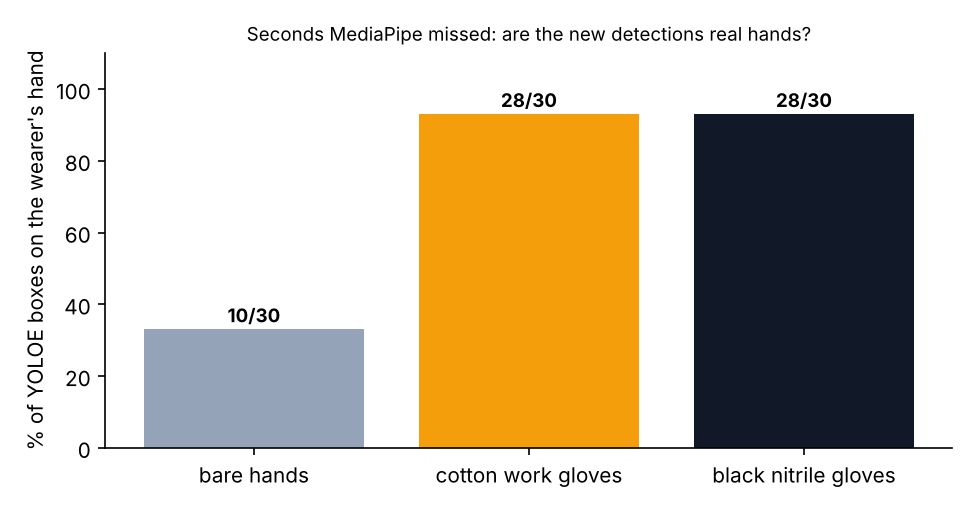
Field Note #30 showed that a standard hand detector (MediaPipe Hands) found 88% of visible bare hands, 50% in cotton work gloves and 4% in black nitrile gloves, so gloved work looked unusable. Here we tested open detectors on the same 90 reviewed seconds and on 450 sampled seconds where MediaPipe had found nothing. YOLOE, an open-vocabulary detector given the text prompt "hand, gloved hand, glove" (confidence 0.5), found 91% of visible cotton-gloved hands and 82% of black-nitrile hands, but only 28% of bare hands. On seconds MediaPipe missed, 28 of 30 YOLOE detections checked by eye were on the wearer's gloved hand for both glove types, against 10 of 30 on bare-hand days. Used by glove type (MediaPipe for bare hands, YOLOE for gloves), the estimated usable time rises from 8.8% to about 48% for black nitrile and from 23.7% to about 57% for cotton gloves, close to the 51.9% of bare-hand days. The footage was always there; the right detector depends on what the worker wears.
Why this matters
A filter that cannot see gloves throws away gloved workplaces
Field Note #30 measured the problem: with a bare-hand detector as the hand check, only 8.8% of black-nitrile footage counted as usable, although the hands were in view almost all the time.
Buyers of egocentric data need gloved work: food, assembly, logistics and labs. This note asks whether an off-the-shelf alternative can see gloved hands, and how much usable time it gives back.
Setup
Same reviewed seconds, two open detectors, one sampling check
Review set: the 90 seconds checked by eye in Field Notes #27 and #30 (30 each: bare hands, cotton work gloves, black nitrile gloves; 75 with a visible hand). Each keyframe went through MediaPipe Hands (as before), a YOLOv4-tiny hand detector trained on bare hands, and YOLOE-11L, an open-vocabulary detector given the text prompt "hand", "gloved hand", "glove".
Sampling check: from the 15-day index (Field Note #30) we drew 150 seconds per condition that passed every image check but in which MediaPipe found no hand, ran YOLOE on each, and checked 30 random detections per condition by eye to see whether the box sat on the wearer's hand.
Everything ran on a 2-core CPU without a GPU; YOLOE-11L took about 3.7 s per 1280-pixel keyframe.
Finding 1
YOLOE sees gloves; MediaPipe sees skin
On the reviewed seconds, YOLOE (confidence 0.5) found 91% of visible cotton-gloved hands and 82% of black-nitrile hands, against 50% and 4% for MediaPipe. It found only 28% of bare hands, where MediaPipe found 88%. Taking either detector found 86–95% of visible hands in every condition. The bare-hand YOLOv4-tiny detector produced boxes in only 8 of 28 nitrile seconds and was not pursued.
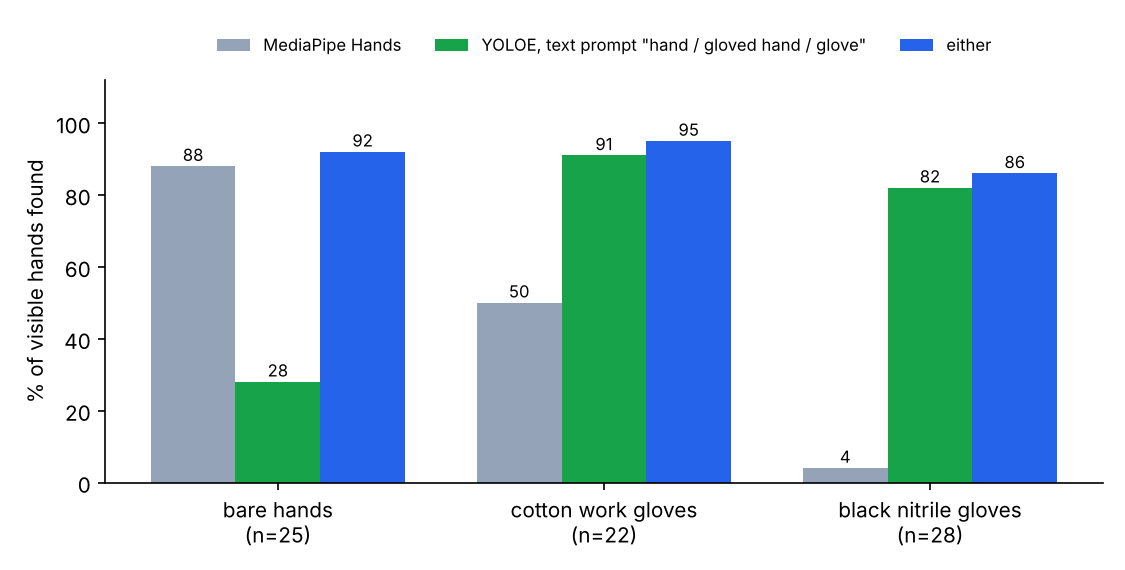
| Bare hands | Cotton work gloves | Black nitrile gloves | |
|---|---|---|---|
| Visible hands reviewed | 25 | 22 | 28 |
| MediaPipe Hands (as in #25, #27, #30) | 22 (88%) | 11 (50%) | 1 (4%) |
| YOLOE, text prompt, confidence ≥ 0.5 | 7 (28%) | 20 (91%) | 23 (82%) |
| Either | 23 (92%) | 21 (95%) | 24 (86%) |
| YOLOv4-tiny hand detector, any box (not checked) | 16 | 9 | 8 |
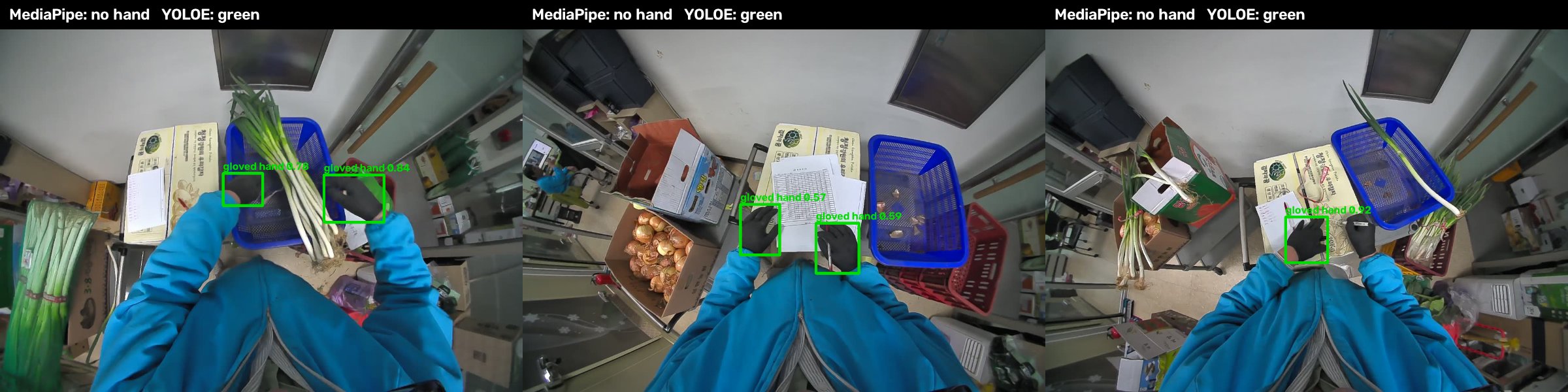
Finding 2
On gloves the new detections are real; on bare hands they are not
In seconds where MediaPipe found nothing, YOLOE fired on 64% (nitrile) and 67% (cotton) of the sampled image-usable seconds. Checked by eye, 28 of 30 of those detections were on the wearer's gloved hand for each glove type. On bare-hand days YOLOE fired on 30%, but only 10 of 30 boxes were on the wearer's hand; the rest were on other people, feet or objects.
The rule that follows is simple: keep MediaPipe for bare hands, use the open-vocabulary detector for gloves.
Finding 3
Gloved days come back to the bare-hand level
Combining the sampled hit rate with the checked precision, a glove-aware hand check would count about 48% of black-nitrile time (5.4 of 11.2 hours) and about 57% of cotton-glove time (5.8 of 10.2 hours) as usable, against 51.9% on bare-hand days with MediaPipe. These are estimates from 150 sampled seconds and 30 checked detections per condition; with that sample size, the black-nitrile figure could plausibly lie between about 38% and 55%.
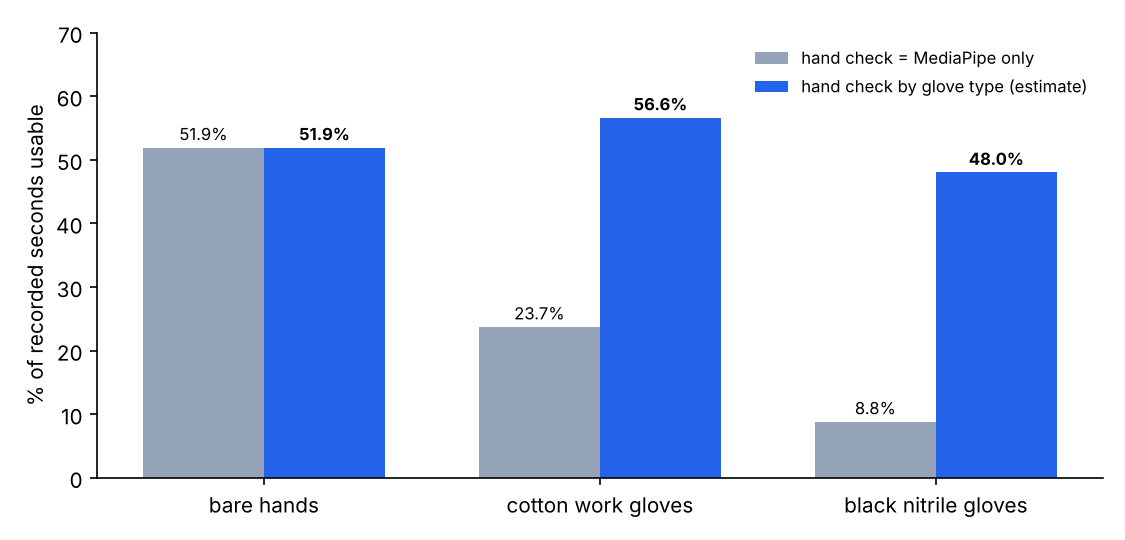
| Bare hands | Cotton work gloves | Black nitrile gloves | |
|---|---|---|---|
| Recorded | 10.35 h | 10.22 h | 11.20 h |
| Image checks passed | 81.1% | 76.0% | 74.5% |
| Usable, MediaPipe hand check | 51.9% (5.38 h) | 23.7% (2.42 h) | 8.8% (0.99 h) |
| Image-usable but no MediaPipe hand | 29.2% | 52.3% | 65.7% |
| YOLOE found a hand there (150 sampled s) | 30.0% | 67.3% | 64.0% |
| Of those, on the wearer's hand (30 checked) | 10/30 | 28/30 | 28/30 |
| Usable, hand check chosen by glove type | 51.9% (5.38 h) | ≈ 56.6% (5.78 h) | ≈ 48.0% (5.38 h) |
What we changed
The hand check now follows the glove
Our per-second index already records hand covering (Field Note #30). The hand check now uses it:
- Bare hands: MediaPipe Hands, as before.
- Gloves: an open-vocabulary detector with a glove prompt, at confidence 0.5.
- For every new site and glove, recall and precision are checked by eye on a small sample before the numbers are reported.
- Deliveries state which detector produced the hand flag for each second.
What this means
Gloved footage is usable; measure it with the right tool
Reviewed on small samples: an open-vocabulary detector found 82–91% of visible gloved hands, with 28 of 30 checked detections correct, where a standard hand model found 4–50%.
Estimated: choosing the detector by glove type brings gloved work back to roughly the usable time of bare-hand work at this site.
For buyers: if a vendor's usable-time numbers drop sharply on gloved sites, ask which detector produced the hand flag. The footage may be fine.
SCOPE AND LIMITS
Limitations
What this note does not show, stated up front.
- One site, one wearer, one rig, two glove types. Other gloves, colours or detectors may differ.
- Recall comes from 75 visible-hand seconds and precision from 30 checked detections per condition; the usable-time figures are estimates from 150 sampled seconds per condition, not a full rerun.
- YOLOE-11L is slow on CPU (about 3.7 s per keyframe); a full run over every second needs a GPU.
- Preliminary analysis: AI-assisted automated analysis plus a small manual review; no third-party review.
FAQ
Questions data buyers ask
Q01How can gloved hands be detected in egocentric video?
Q02Should an open-vocabulary detector replace MediaPipe Hands?
Q03How much usable time does a glove-aware hand check recover?
OPEN DATA AND CODE
Reproduce and inspect the evidence
Every number in this note can be checked: derived tables, analysis code, figures and a runnable notebook are public.
 GitHubAnalysis code and reproduction steps
origin-data-lab/finding-gloved-hands-open-vocabulary-detector-egocentricView repository  Hugging FaceDataset card, tables and figures
origin-data-lab/finding-gloved-hands-open-vocabulary-detector-egocentricOpen dataset  Data explorer and runnable notebook
origindatalab/odl-gloved-hand-detection-yoloe-mediapipeExplore on Kaggle Licence: CC BY 4.0 (data and figures) · MIT (code)
Origin Data Lab (2026). Technical Field Note #31: Finding gloved hands. https://origindatalab.io/technical-field-notes/finding-gloved-hands-open-vocabulary-detector-egocentric.html
CONTINUE READING
Related field notes
Want this measured on your data?
Origin Data Lab plans and runs egocentric, stereo+IMU and field video capture with documented QA, for physical AI and robotics teams.