Technical Field Note #25 · November 2026
How much of 2.6 hours of egocentric work video is usable? A per-second QC index: 85% sharp, about half with hands at work
Field Note #25 · Usable-time QC for egocentric stereo+IMU capture (ODL-EGO S1): one row per second, raw footage untouched
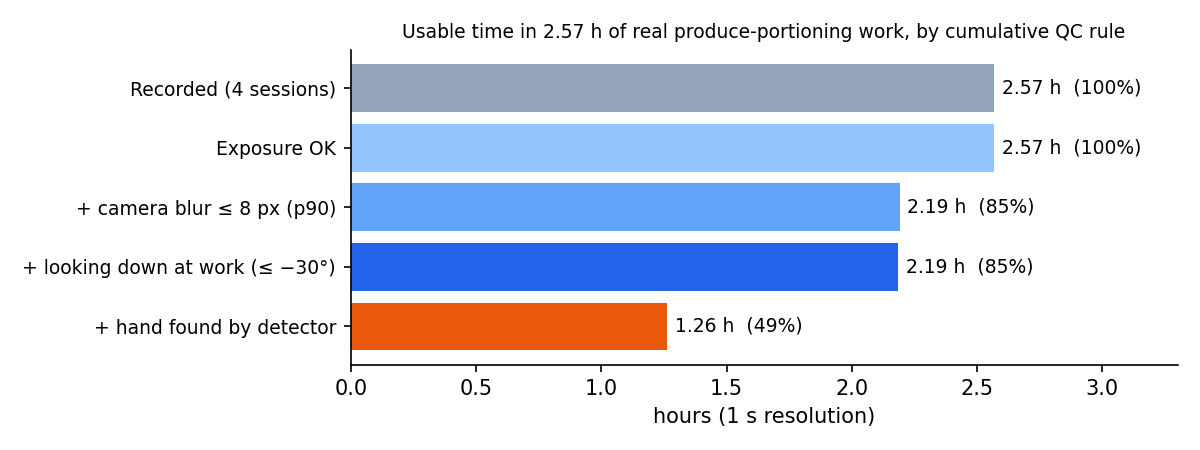
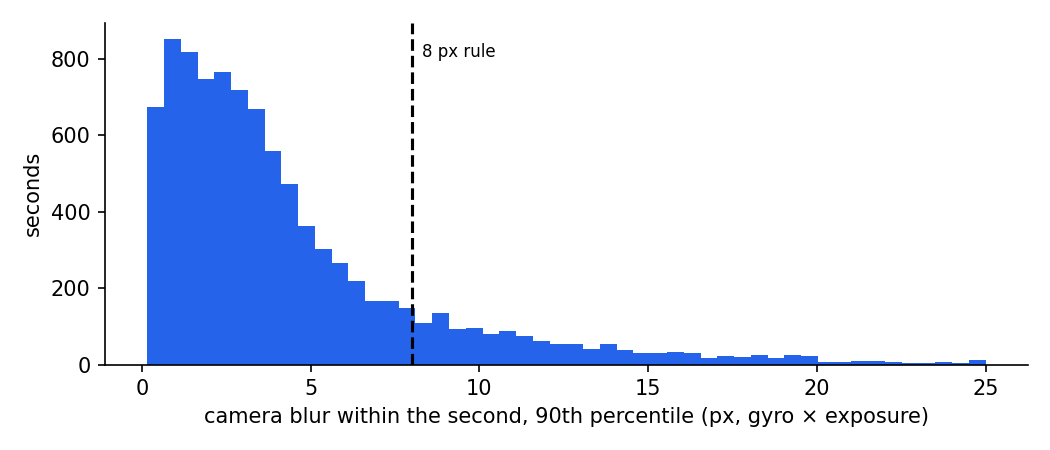
Buyers pay for usable hours, not recorded hours, so we measure usable time second by second. For 2.57 hours of real produce-portioning work recorded on 2026-11-08 (four sessions, 9,246 seconds), we built a QC index with one row per second and four checks: exposure from the image, camera motion blur from the gyroscope and exposure time, view direction from the accelerometer, and hand presence from a hand detector. Exposure passed in all but one second. Camera blur stayed within 8 px (90th percentile in the second) for 85.4% of seconds; median blur was 1.6 px at a median head speed of 19.6°/s. The camera pointed down at the work in 99.8% of seconds. A hand was detected in 56.7%. Combined, 49.2% of seconds (1.26 h) passed every check, 39–59% per session. Hand detection is the limiting check and misses hands (Field Note #23): in 60 reviewed seconds, 55% actually had a visible hand with a usable image versus 37% by the detector, so the true usable share is nearer 55% (about 1.4 h). Usable stretches are short: half last 2 s or less, and stretches of 10 s or more carry 34–47% of usable time. The raw footage is never cut; the index is stored next to it and applied only at export.
Why this matters
Recorded hours are not usable hours
Every egocentric recording contains time a buyer cannot use: the camera swinging during a head turn, the wearer walking to fetch a box, hands out of view. A vendor that reports recorded hours leaves the buyer to discover the difference. We want to report usable hours, define them explicitly and let the buyer change the definition.
This note builds that measurement on one real working day and shows what the numbers look like.
Setup
One row per second, four independent signals
Recording: 2026-11-08, produce portioning for school meals, four sessions (24, 33, 53 and 44 min, 9,246 s in total), R8 stereo+IMU rig (ODL-EGO S1) on the head, 1600×1200 at 30 fps, 500 Hz IMU on the same clock.
For each second: image exposure from one left-eye keyframe; camera blur from the gyroscope over each frame's exposure window (rotation rate × exposure × 482 px focal length, as in Field Note #15); camera pitch from the averaged accelerometer (as in Field Note #17); hands from MediaPipe with the full-frame and lower-region passes of Field Note #23. Thresholds are listed below and are parameters, not fixed truths.
| Check (per second) | Source | Rule | Seconds passing |
|---|---|---|---|
| Exposure | left image, 1 frame/s | mean 40–200, < 10% saturated, < 20% black | 100.0% |
| Camera motion blur | gyroscope × exposure time × focal length | 90th percentile within the second ≤ 8 px | 85.4% |
| Looking at the work | accelerometer (gravity) → camera pitch | ≤ −30° (pointing down) | 99.8% |
| Hand present | MediaPipe, full frame + lower work region (Field Note #23) | ≥ 1 hand found | 56.7% |
| Usable for manipulation | all of the above | 49.2% (1.26 h) |
Finding 1
Image quality is rarely the problem; hands are
Exposure failed in one second of 9,246. The camera pointed down at the work bench (pitch ≤ −30°) in 99.8% of seconds, median −66°. Camera blur was the main image-quality loss: 14.6% of seconds had a 90th-percentile blur above 8 px, caused by fast head turns; median blur was 1.6 px.
Hand presence decided the rest. With all four checks, 49.2% of seconds (1.26 h) were usable for manipulation learning, from 39.5% in the last session (more walking and fetching) to 58.9% in the longest one.
| Session | Minutes | Blur OK | Hand found | Usable for manipulation | Median head speed | Median camera blur |
|---|---|---|---|---|---|---|
| 09:32 | 24 | 83.5% | 55.2% | 47.5% | 19.5°/s | 1.6 px |
| 10:00 | 33 | 84.8% | 54.5% | 47.8% | 18.1°/s | 1.5 px |
| 10:49 | 53 | 86.0% | 67.2% | 58.9% | 17.7°/s | 1.5 px |
| 11:48 | 44 | 86.1% | 46.3% | 39.5% | 22.5°/s | 1.9 px |
| All | 154 | 85.4% | 56.7% | 49.2% | 19.6°/s | 1.6 px |
Finding 2
Correcting for the detector: about 55%, not 49%
Field Note #23 showed that even the improved detector finds only part of the visible hands. On the same 60 reviewed seconds, 33 (55%) had a visible hand, a usable image and the camera on the work; the detector-based rule passed 22 (37%). The detector-based figure is therefore a lower bound; the reviewed estimate is about 55% (95% CI 42–67%), roughly 1.4 of 2.57 hours.
Finding 3
Usable time comes in short pieces
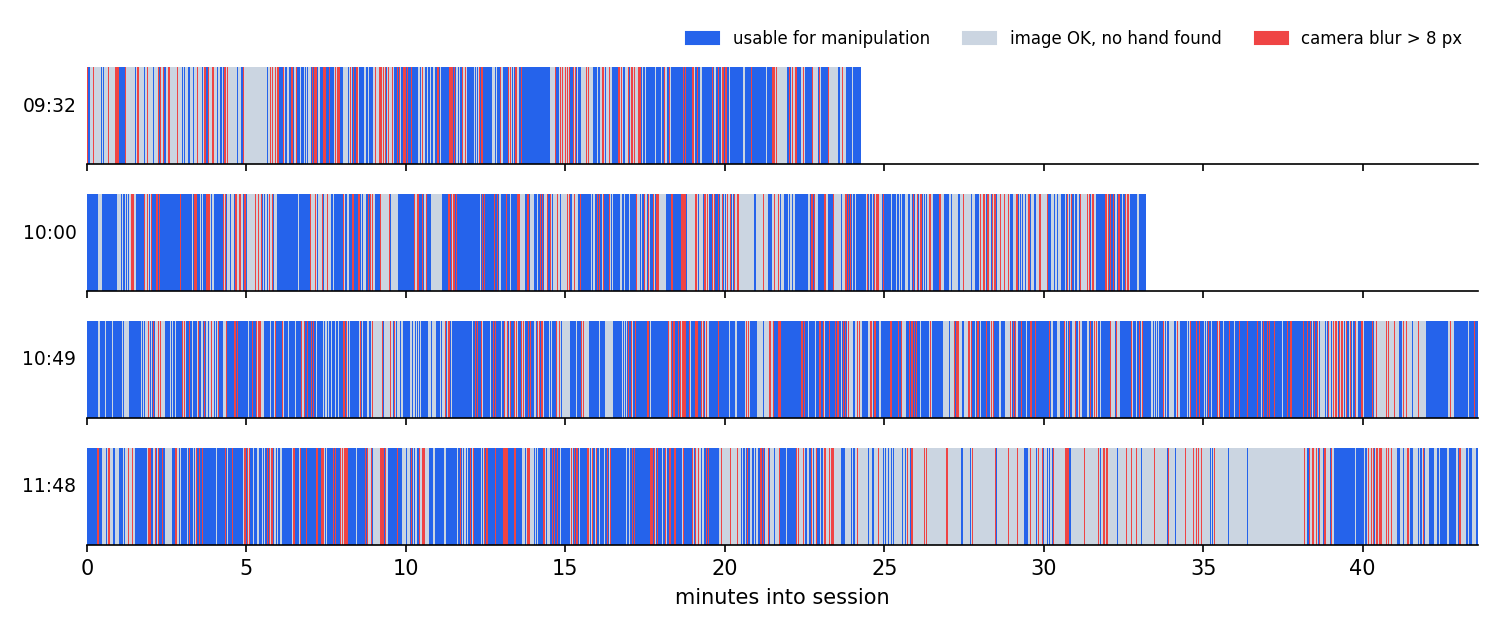
Usable seconds alternate with brief head turns and reaches out of view. The median usable stretch was 2 seconds, and stretches of 10 s or longer carried only 34–47% of usable time per session. A buyer who needs continuous 10-second episodes gets less than half of the usable total; one who trains on short clips or single frames gets all of it.
How this is built
Raw stays raw; the index travels with it
The index is a CSV with one row per second per session: time, exposure, brightness, blur percentiles, head speed, pitch and hand count, plus the pass/fail columns. It is computed on the server after upload and stored next to the untouched recording. Cutting, privacy blurring and episode selection happen only at export, with the buyer's thresholds.
- Change a threshold, re-export: no re-recording, no re-processing of video.
- Every delivery states recorded hours, usable hours and the rules that produced them.
- Hand presence is reported with its reviewed recall (Field Note #23).
What this means
Usable time, measured per second and adjustable
Verified: on this working day, 85% of recorded seconds had sharp, well-exposed images and about half to 55% were usable for hand-manipulation learning under the stated rules.
For buyers: ask any vendor for usable hours and the rules behind them. Ours come as a per-second table you can re-threshold yourself.
SCOPE AND LIMITS
Limitations
What this note does not show, stated up front.
- One wearer, one task, one rig, one day.
- Image checks use one keyframe per second; blur comes from camera rotation only (not object motion or defocus).
- Hand presence relies on a detector that misses hands; the corrected estimate rests on a 60-second AI visual review, not human annotation.
- Thresholds (8 px, −30°, exposure bounds) are our working defaults, not a standard.
- Preliminary analysis: AI-assisted automated analysis; no third-party review.
FAQ
Questions data buyers ask
Q01How much of egocentric work video is usable for robot learning?
Q02How do you measure motion blur without looking at every frame?
Q03What removes the most usable time?
Q04Is the raw video cut?
Q05How long are the usable stretches?
OPEN DATA AND CODE
Reproduce and inspect the evidence
Every number in this note can be checked: derived tables, analysis code, figures and a runnable notebook are public.
 GitHubAnalysis code and reproduction steps
origin-data-lab/per-second-usable-time-qc-egocentric-workView repository  Hugging FaceDataset card, tables and figures
origin-data-lab/per-second-usable-time-qc-egocentric-workOpen dataset  Data explorer and runnable notebook
origindatalab/odl-egocentric-usable-time-qcExplore on Kaggle Licence: CC BY 4.0 (data and figures) · MIT (code)
Origin Data Lab (2026). Technical Field Note #25: How much of 2.6 hours of egocentric work video is usable? https://origindatalab.io/technical-field-notes/per-second-usable-time-qc-egocentric-work.html
CONTINUE READING
Related field notes
Want this measured on your data?
Origin Data Lab plans and runs egocentric, stereo+IMU and field video capture with documented QA, for physical AI and robotics teams.