Technical Field Note #19 · November 2026
Four days of real work, 8.9 hours, 957,336 stereo frames: does a head-mounted stereo+IMU rig behave the same every day?
Field Note #19 · Day-to-day consistency of a head-mounted stereo+IMU rig over four days of real work (ODL-EGO S1)
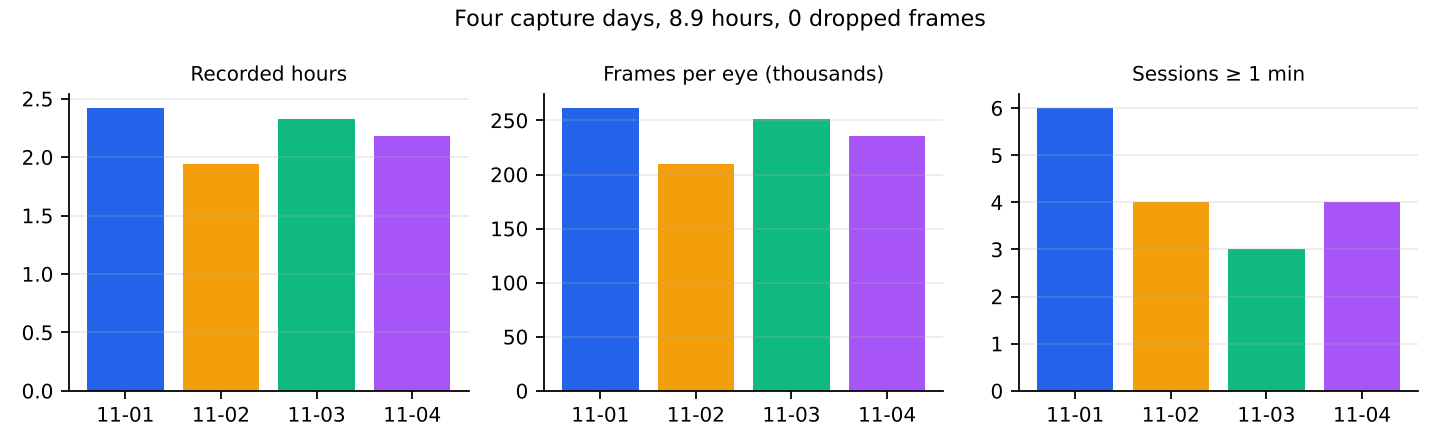
Field Note #16 showed that one morning of real work came through intact. A buyer of hundreds of hours needs more: the same behaviour every day, after the rig has been charged, carried, put on and taken off again. We recorded the same produce-portioning job on four consecutive mornings (2026-11-01 to 11-04) and ran the same checks on all of it: 17 work sessions, 8.9 hours, 957,336 frames per eye. Every day had zero dropped frames, a 15 µs median left/right exposure difference (worst case 61–70 µs per day), an IMU rate of 501.4–501.7 Hz with no sequence breaks and no gap above 2.2 ms, seamless 5-minute file boundaries, and a 10.04 ms median exposure. Head-motion statistics from the IMU were also nearly identical across days. The only irregularities were operational: three accidental recordings shorter than 2 s and one session whose device log lacks a stop entry although its data are complete.
Why this matters
One good morning is not a production rig
Most capture-rig validations stop at one recording. Production data are collected day after day: batteries are recharged, the rig is carried, worn, taken off and powered up again, and the storage card fills and empties. Each of these can change behaviour.
This note repeats the integrity checks of Field Note #16 on four consecutive days of the same real job and asks one question: is day four indistinguishable from day one?
Setup
Same job, same operator, four mornings
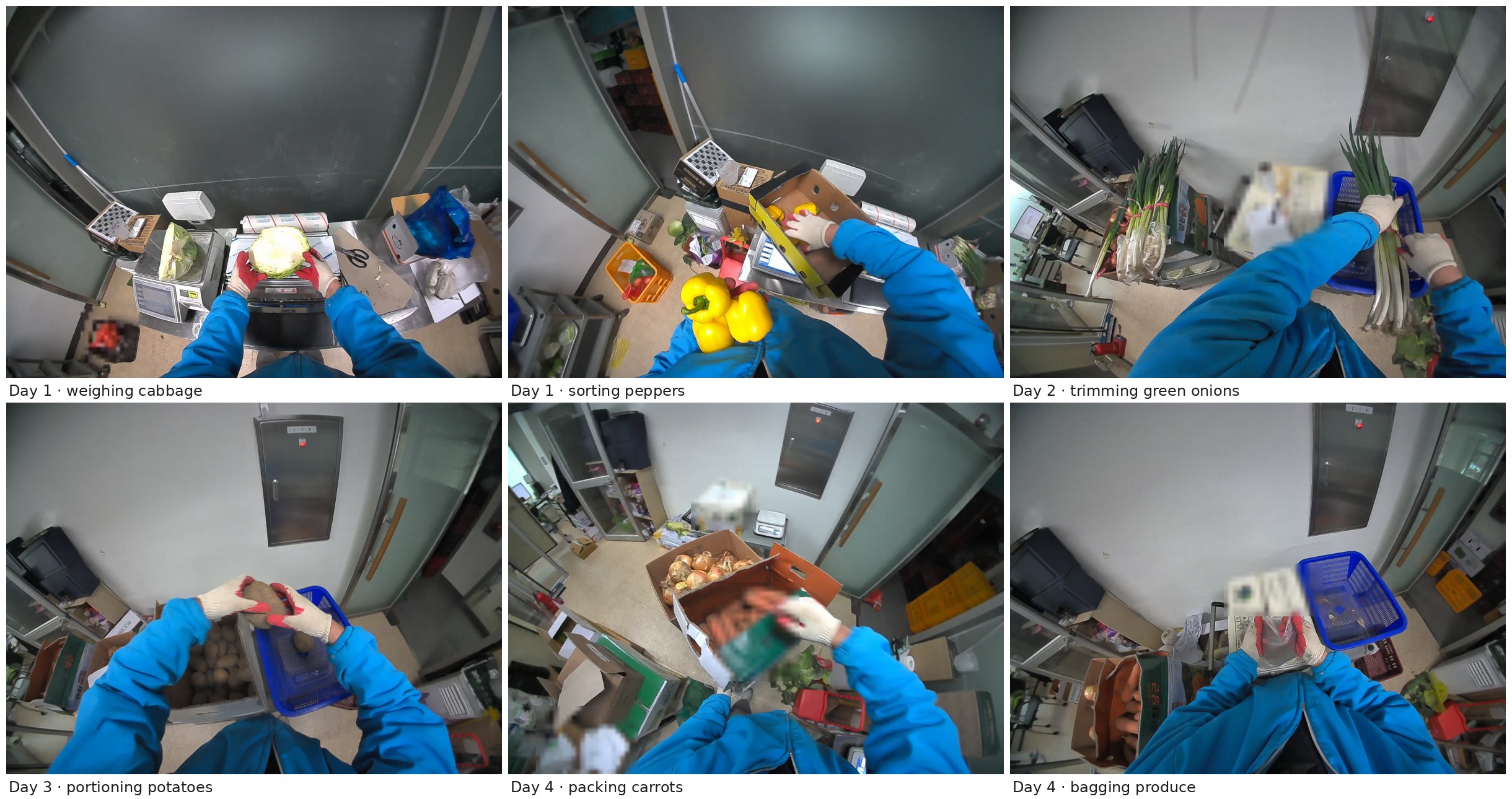
Produce portioning for school meals in a food supplier's workroom: weighing, trimming, sorting and bagging vegetables. The rig was worn on the head; recording was started and stopped by the operator. Site, people and labels in the images below are blurred or cropped.
| Day | Sessions | Hours | Frames per eye | Dropped | L/R median (µs) | L/R max (µs) | Gyro rate (Hz) | IMU max gap (ms) | Exposure median (ms) | Head rotation median (°/s) | p95 (°/s) |
|---|---|---|---|---|---|---|---|---|---|---|---|
| 2026-11-01 | 6 | 2.42 | 261,390 | 0 | 15 | 70 | 501.571–501.644 | 2.19 | 10.04 | 27.5 | 95.1 |
| 2026-11-02 | 4 | 1.94 | 209,455 | 0 | 15 | 64 | 501.582–501.623 | 2.11 | 10.04 | 28.1 | 91.4 |
| 2026-11-03 | 3 | 2.33 | 250,935 | 0 | 15 | 65 | 501.357–501.637 | 2.2 | 10.04 | 28.5 | 92.2 |
| 2026-11-04 | 4 | 2.18 | 235,515 | 0 | 15 | 61 | 501.598–501.688 | 2.11 | 10.04 | 29.7 | 94.3 |
Timing and IMU
Every day looked like the first day
Frames: no drops on any day by interval counting; for every session with a stop entry, the device log's frame counts matched the frames in the files (to within the one final frame) and reported zero strobe drops. All 5-minute file boundaries followed after exactly one frame period (33.3 ms).
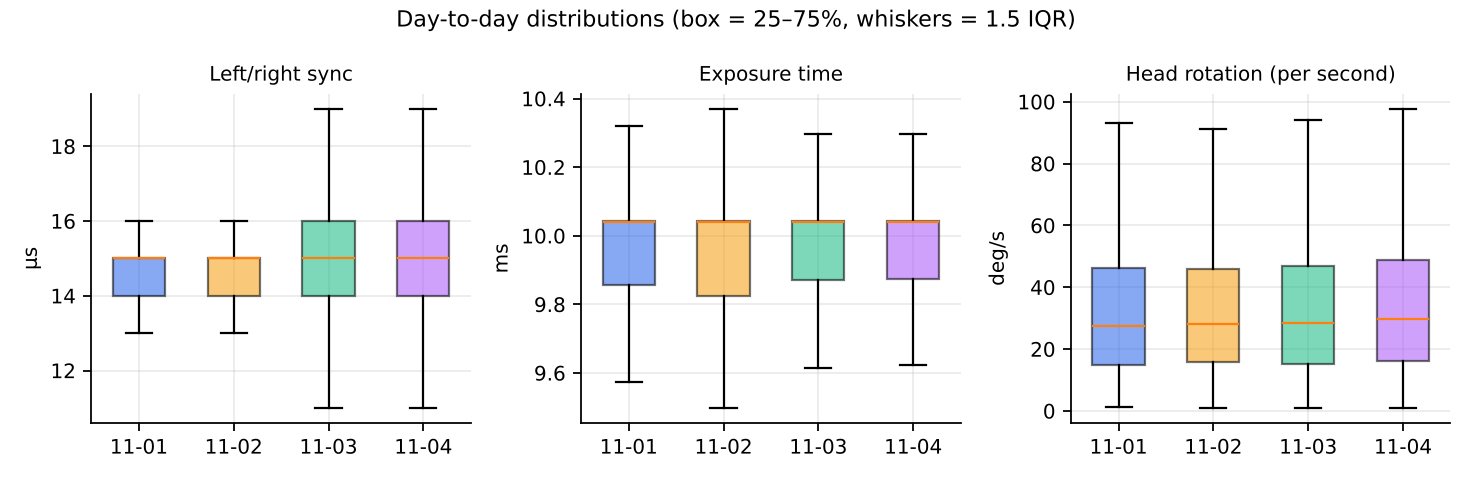
Stereo sync (pairs by frame order, see Field Note #18): the exposure-start difference had a 15 µs median every day and a daily maximum between 61 and 70 µs. Exposure: 10.04 ms median every day, 95th percentile 10.54–10.56 ms.
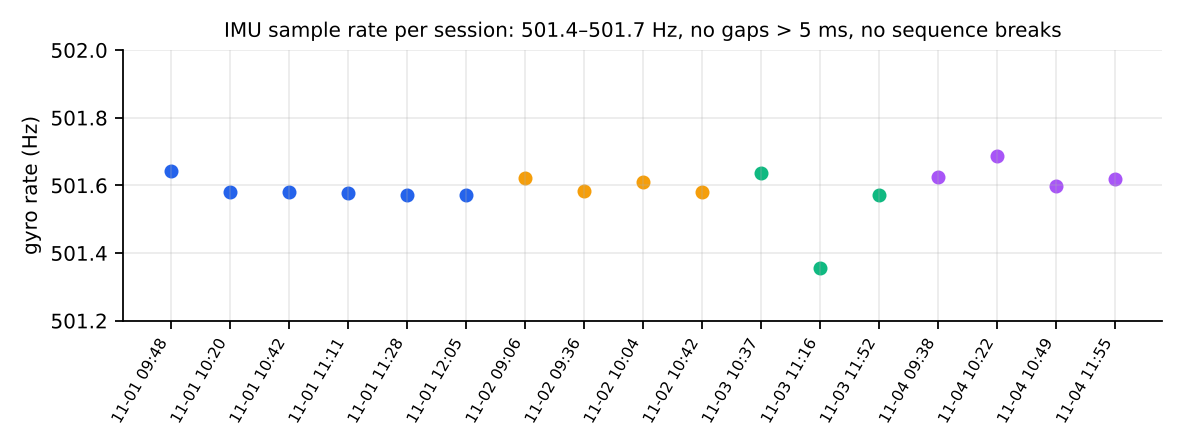
IMU: 501.4–501.7 Hz in every session (the device's nominal rate is 500 Hz), largest inter-sample gap 2.2 ms, zero sequence breaks, and gyro and accelerometer sample counts identical in every file.
| Day | Start | Minutes | Files | Frames per eye | Dropped | L/R max (µs) | Gyro (Hz) | IMU max gap (ms) | File boundary gap (ms) | Device log stop |
|---|---|---|---|---|---|---|---|---|---|---|
| 11-01 | 09:48 | 27.5 | 6 | 49,473 | 0 | 57 | 501.644 | 2.11 | 33.3-33.3 | user_stop |
| 11-01 | 10:20 | 17.9 | 4 | 32,225 | 0 | 52 | 501.582 | 2.11 | 33.3-33.3 | user_stop |
| 11-01 | 10:42 | 21.7 | 5 | 38,998 | 0 | 55 | 501.582 | 2.11 | 33.3-33.3 | user_stop |
| 11-01 | 11:11 | 14.1 | 3 | 25,334 | 0 | 70 | 501.579 | 2.19 | 33.3-33.3 | user_stop |
| 11-01 | 11:28 | 32.2 | 7 | 58,015 | 0 | 67 | 501.572 | 2.11 | 33.3-33.3 | user_stop |
| 11-01 | 12:05 | 31.9 | 7 | 57,345 | 0 | 56 | 501.571 | 2.11 | 33.3-33.3 | missing |
| 11-02 | 09:06 | 27.8 | 6 | 50,105 | 0 | 64 | 501.623 | 2.11 | 33.3-33.3 | user_stop |
| 11-02 | 09:36 | 22.2 | 5 | 39,957 | 0 | 51 | 501.584 | 2.11 | 33.3-33.3 | user_stop |
| 11-02 | 10:04 | 17.6 | 4 | 31,605 | 0 | 59 | 501.609 | 2.11 | 33.3-33.3 | user_stop |
| 11-02 | 10:42 | 48.8 | 10 | 87,788 | 0 | 57 | 501.582 | 2.11 | 33.3-33.3 | user_stop |
| 11-03 | 10:37 | 35.8 | 8 | 64,380 | 0 | 59 | 501.637 | 2.11 | 33.3-33.3 | user_stop |
| 11-03 | 11:16 | 30.1 | 7 | 54,130 | 0 | 59 | 501.357 | 2.2 | 33.3-33.3 | user_stop |
| 11-03 | 11:52 | 73.6 | 15 | 132,425 | 0 | 65 | 501.572 | 2.11 | 33.3-33.3 | user_stop |
| 11-04 | 09:38 | 40.0 | 9 | 72,024 | 0 | 57 | 501.626 | 2.11 | 33.3-33.3 | user_stop |
| 11-04 | 10:22 | 23.0 | 5 | 41,431 | 0 | 57 | 501.688 | 2.11 | 33.3-33.3 | user_stop |
| 11-04 | 10:49 | 40.4 | 9 | 72,802 | 0 | 61 | 501.598 | 2.11 | 33.3-33.3 | user_stop |
| 11-04 | 11:55 | 27.4 | 6 | 49,258 | 0 | 56 | 501.618 | 2.11 | 33.3-33.3 | user_stop |
Work rhythm
The same job leaves the same motion signature
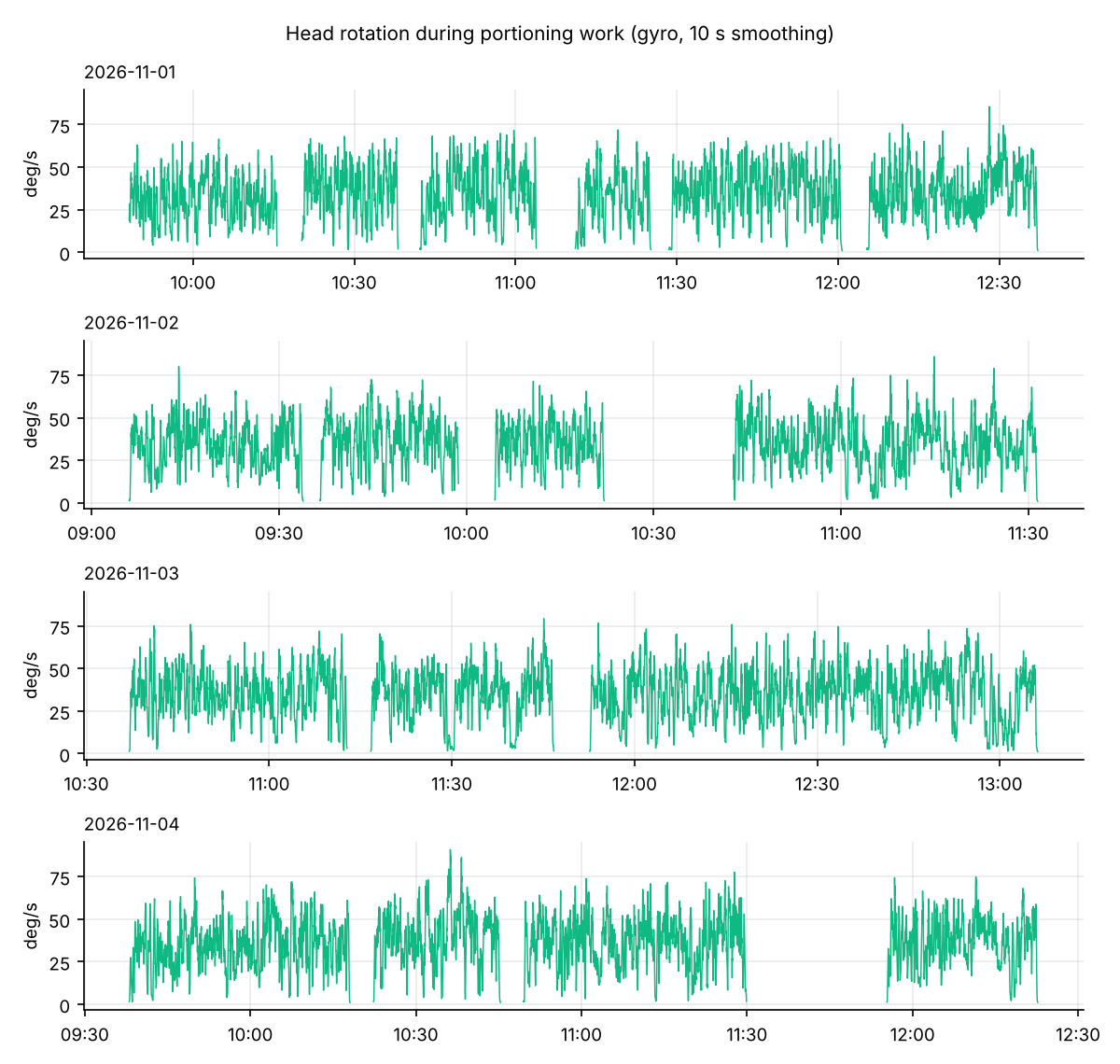
From the gyroscope we computed the mean head-rotation speed for every second of recording. The daily median was 27.5–29.7 °/s and the 95th percentile 91–95 °/s; 5.6–7.4% of seconds were nearly still (< 5 °/s). The rhythm of reaching, weighing and bagging is visible as a steady band, interrupted by breaks between sessions.
Note on method: these are per-second means, so they are higher than the per-frame median of 22 °/s reported in Field Note #15 for day 1, which weights still frames more heavily. The two notes agree when the same method is used.
Irregularities
What did go wrong, and why it did not cost data
- Three accidental recordings of 0.2–1.2 s (one on day 2, two on day 4), most likely from a double press of the record button. They contain 0–24 frames and are dropped automatically by a 60 s minimum-length rule.
- One session (day 1, 12:05) has no stop entry in the device log, consistent with power-off before stop. Its 57,345 frames per eye and its IMU stream are complete; only the log line is missing.
- In 8 of 118 files the left and right frame counts differ by one; all are the final file of a session (see Field Note #18).
Calibration was not re-checked in this note. The calibration file saved inside each recording folder belongs to a different resolution (Field Note #20); the correct-mode check over a full shift is reported in Field Note #16.
What we changed
Daily QA, not one-off validation
Verified: across four days of real work the rig's frame, sync, IMU and exposure behaviour did not change measurably.
Process: recordings are now uploaded automatically every night with SHA-256 verification, and the same analysis runs on a short-lived cloud server, so these numbers are produced for every capture day rather than once.
SCOPE AND LIMITS
Limitations
What this note does not show, stated up front.
- One rig, one operator, one workroom, four mornings; not a population estimate.
- Head-rotation statistics are per-second means of gyro speed and are not directly comparable to per-frame statistics.
- Calibration and metric scale were not re-checked in this note.
- All checks are automated: AI/algorithm-only preliminary analysis; no human re-verification.
FAQ
Questions data buyers ask
Q01Does the stereo+IMU rig behave the same from day to day?
Q02How much data was recorded?
Q03Were there any problems?
Q04Does head motion differ between days?
Q05Was calibration checked over the four days?
OPEN DATA AND CODE
Reproduce and inspect the evidence
Every number in this note can be checked: derived tables, analysis code, figures and a runnable notebook are public.
 GitHubAnalysis code and reproduction steps
origin-data-lab/four-day-real-work-stereo-imu-consistencyView repository  Hugging FaceDataset card, tables and figures
origin-data-lab/four-day-real-work-stereo-imu-consistencyOpen dataset  Data explorer and runnable notebook
origindatalab/odl-four-day-stereo-imu-consistencyExplore on Kaggle Licence: CC BY 4.0 (data and figures) · MIT (code)
Origin Data Lab (2026). Technical Field Note #19: Four days of real work with a head-mounted stereo+IMU rig. https://origindatalab.io/technical-field-notes/four-day-real-work-stereo-imu-consistency.html
Want this measured on your data?
Origin Data Lab plans and runs egocentric, stereo+IMU and field video capture with documented QA, for physical AI and robotics teams.