TECHNICAL FIELD NOTE #03 · OCTOBER 2026
Stereo + IMU Egocentric Capture
Based on a 120-second recording of a real manual task captured with a head-mounted stereo camera and six-axis IMU, we examine left–right frame correspondence, exposure-midpoint timing, IMU continuity, camera–IMU time-offset estimation, and calibration limitations.
This is a technical evaluation of one device in one capture mode. It does not constitute final approval of production-grade stereo calibration or precise camera–IMU synchronization.
Synchronization, Timing and Calibration Evaluation
Capture Configuration
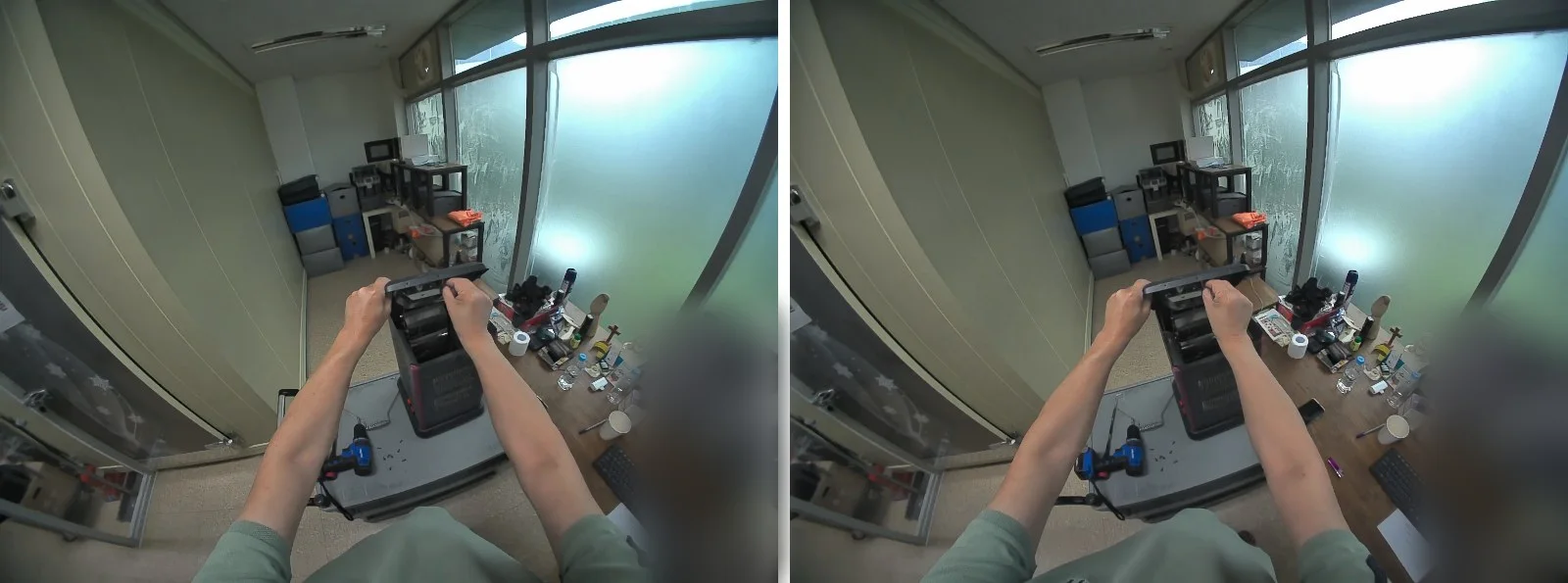
We recorded a two-handed case-assembly task at an indoor workbench using a power drill and hand tools. Each left and right video stream contains 3,600 frames at 1600×1200 and 30 fps, sharing device frame ticks. Exposure start time and duration are recorded for each frame in H.264 SEI messages.
Exposure Midpoints, Not Frame Ticks
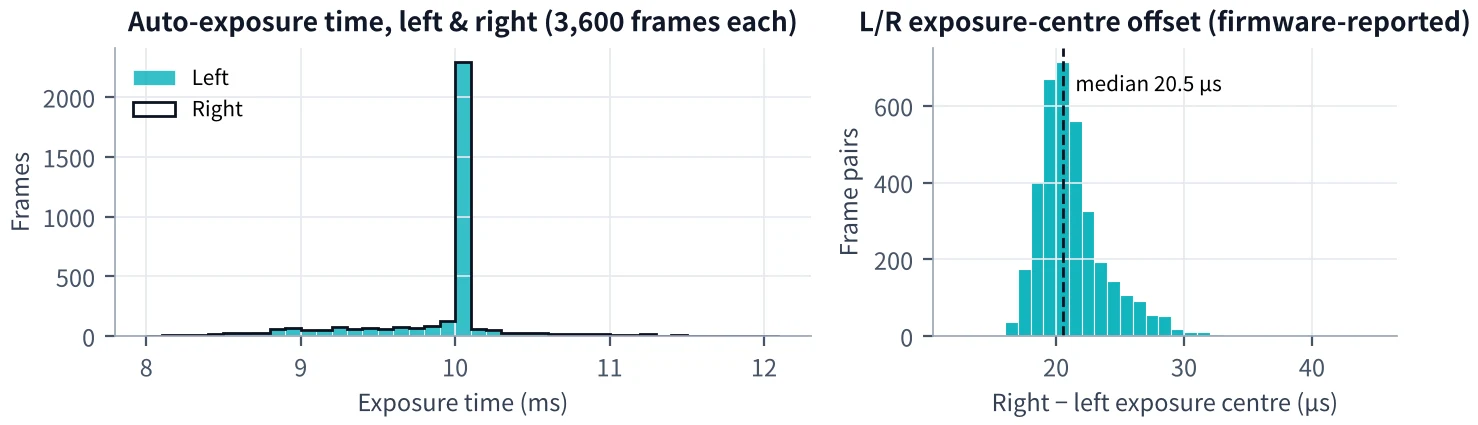
A camera frame integrates light over an exposure interval rather than representing a single instant. Due to automatic exposure, exposure durations in this recording range from approximately 8.1 to 12.0 ms. Therefore, video and sensor timing should be compared using theexposure midpoint (exposure start + half the exposure duration). MP4 presentation timestamps (PTS) occur at regular 1/30-second intervals and are not a substitute for the device-recorded exposure timestamps.
Left–Right Stereo Synchronization Checks
| Check | Method | Result | Status |
|---|---|---|---|
| Frame ticks | SEI tick comparison | 3,600/3,600 pairs matched; 33,333 µs interval | Verified |
| Frame continuity | Strobe counter | Increment of +1 per frame on both sides; zero missing | Verified |
| Visual frame correspondence | Correlation of global image motion between views | Peak at zero-frame lag; r=0.997 | Verified |
| Exposure-midpoint difference | Comparison of device-reported values | Median 20.5 µs; mean 21.1 ± 2.9 µs | Device-reported |
Multiple independent checks support frame-level correspondence. However, microsecond-scale exposure differences are firmware-reported values and have not been independently verified from 30 fps video alone. External validation would require, for example, a flashing LED visible to both cameras.
IMU Stream
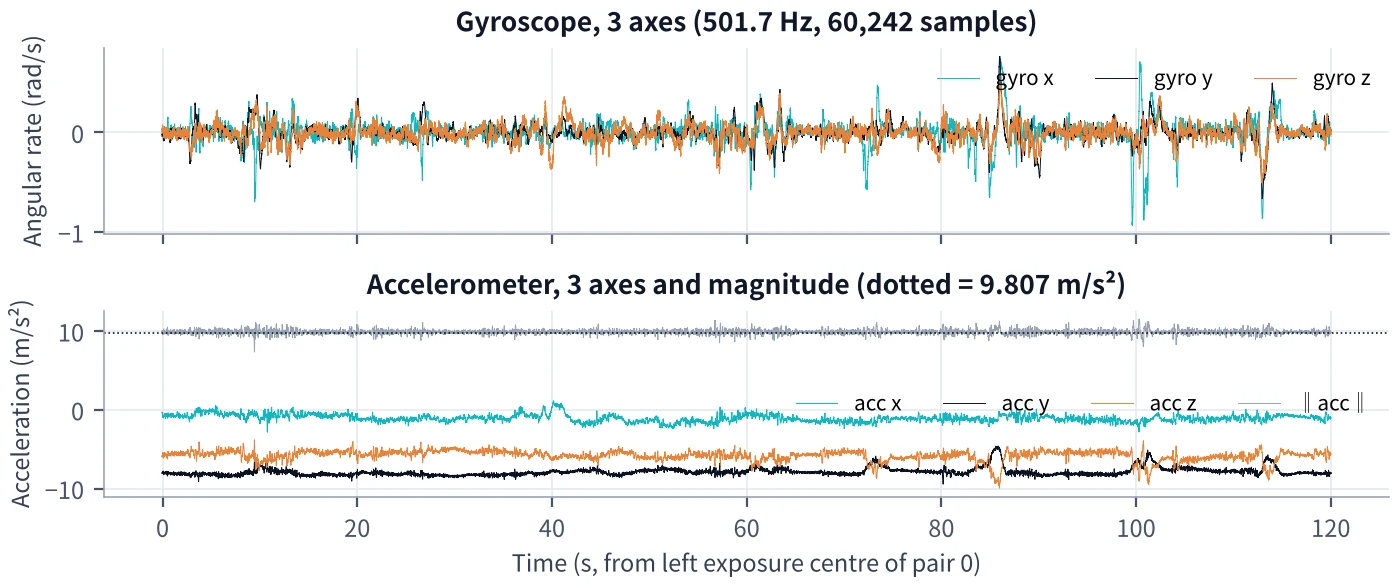
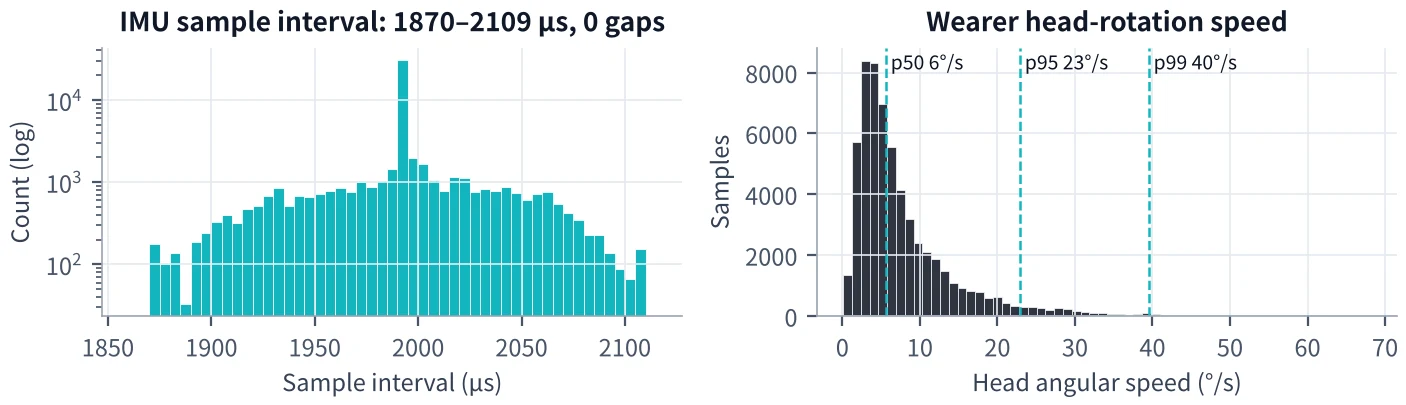
The six-axis IMU was sampled at an average rate of approximately501.7Hzin a recording that uses a shared clock with the video. No interval outliers, duplicates, missing samples, or sensor saturation were observed within the tested scope. IMU coverage begins approximately 48 ms before the first video exposure and ends approximately 48 ms after the last exposure.
Target-Free Camera–IMU Time-Offset Estimation
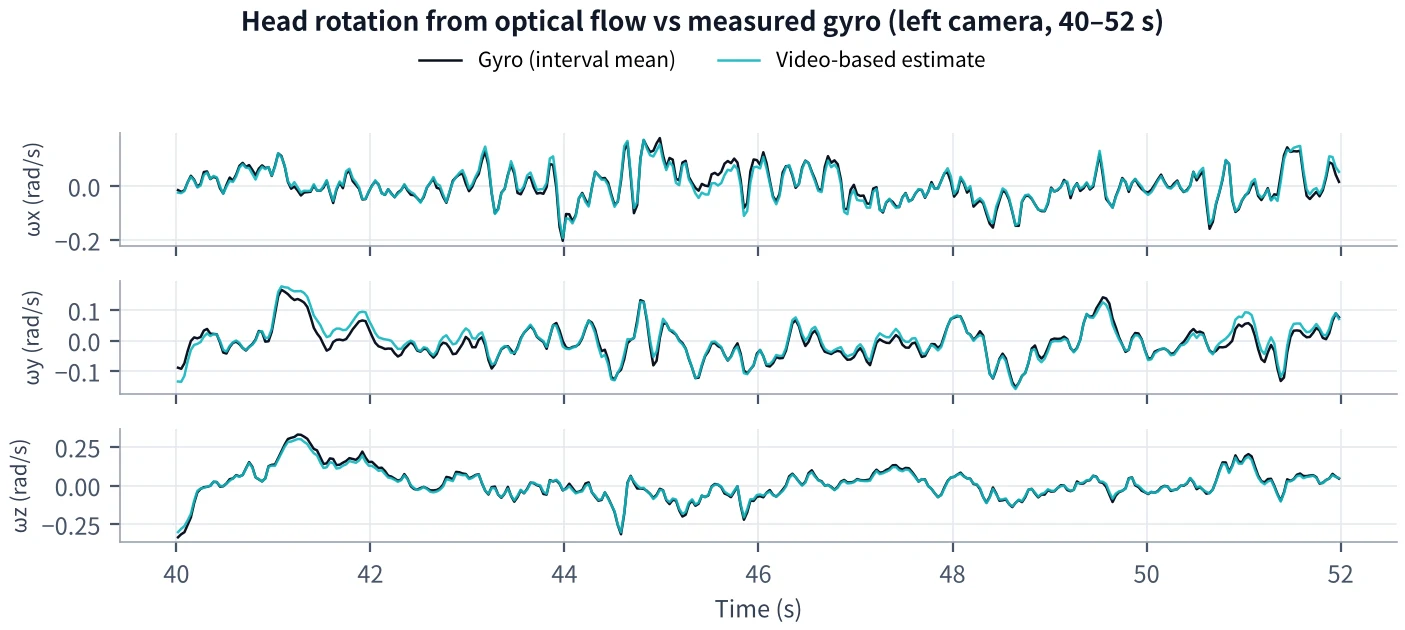
Even with a common device clock, relative delays may arise along the camera and IMU processing paths. Weestimatedthe offset by comparing visually derived head rotation with gyroscope measurements.
- Computed inter-frame motion at 400×300 resolution using Lucas–Kanade optical flow and a RANSAC similarity transform.
- Averaged gyroscope signals over intervals between exposure midpoints.
- Fitted a 3×3 linear mapping and bias between visual motion and angular velocity using least squares.
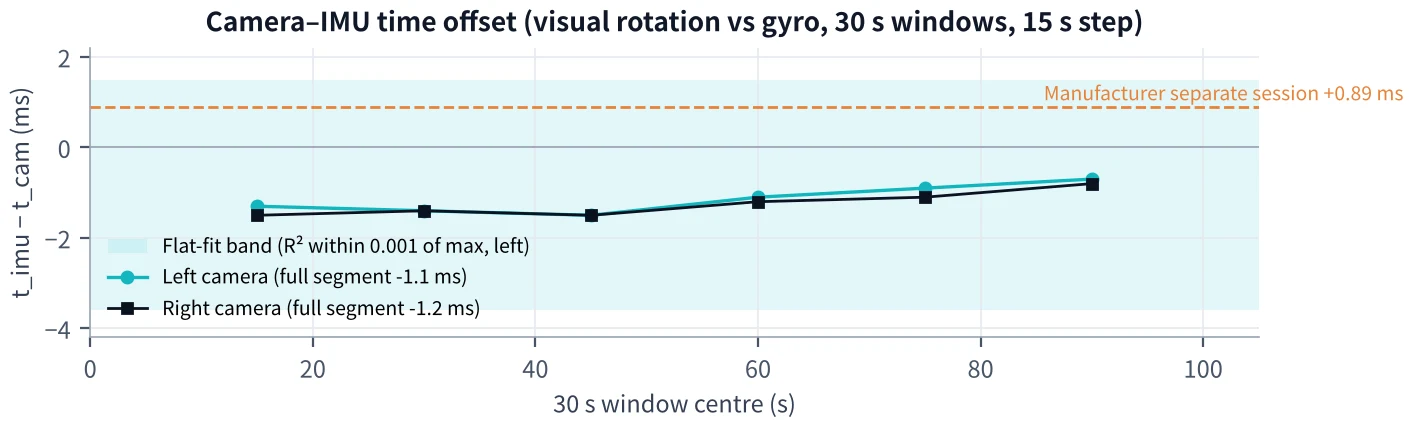
- Searched −6 to +6 ms in 0.1 ms increments and checked stability across six 30-second windows.
| Metric | Left camera | Right camera |
|---|---|---|
| Best full-recording offset | −1.1ms | −1.2ms |
| Fit R² | 0.973 | 0.974 |
| 30-second window range | −1.5~−0.7ms | −1.5~−0.8ms |
These results support the possibility of camera–IMU alignment within a few milliseconds for this device and mode, but do not establish a final production time offset. Manufacturer calibration performed in a different sensor mode reports +0.89/+0.95 ms; the discrepancy remains unresolved. Update (23 October 2026): A later comparison against Kalibr calibration on another recording found a several-millisecond disagreement. These estimates are not a validated production camera–IMU time shift.
Calibration Finding
Stereo Calibration Must Match the Sensor Mode
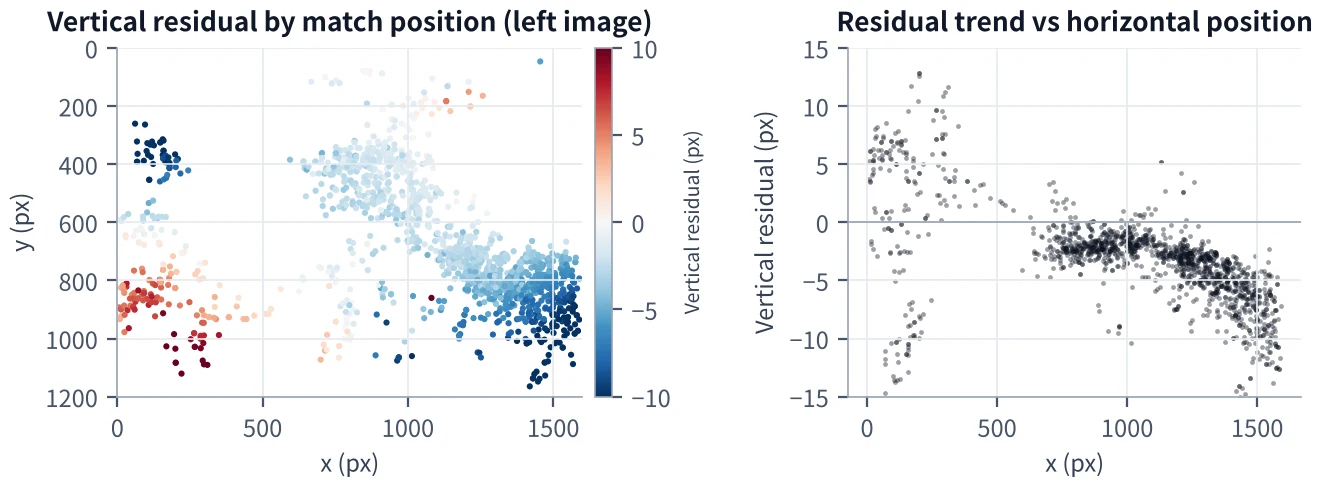
The calibration file supplied with the device reports an excellent stereo RMS of 0.362 px. Its principal points, however, sit near the centre of a 1920×1080 (16:9) image, while this recording used a 1600×1200 (4:3) mode. Applied to the recorded frames, the parameters leave a median vertical residual of 3.409 px (p95 10.388 px) between matched left/right points after rectification, on 1,496 points from four held-out timestamps.
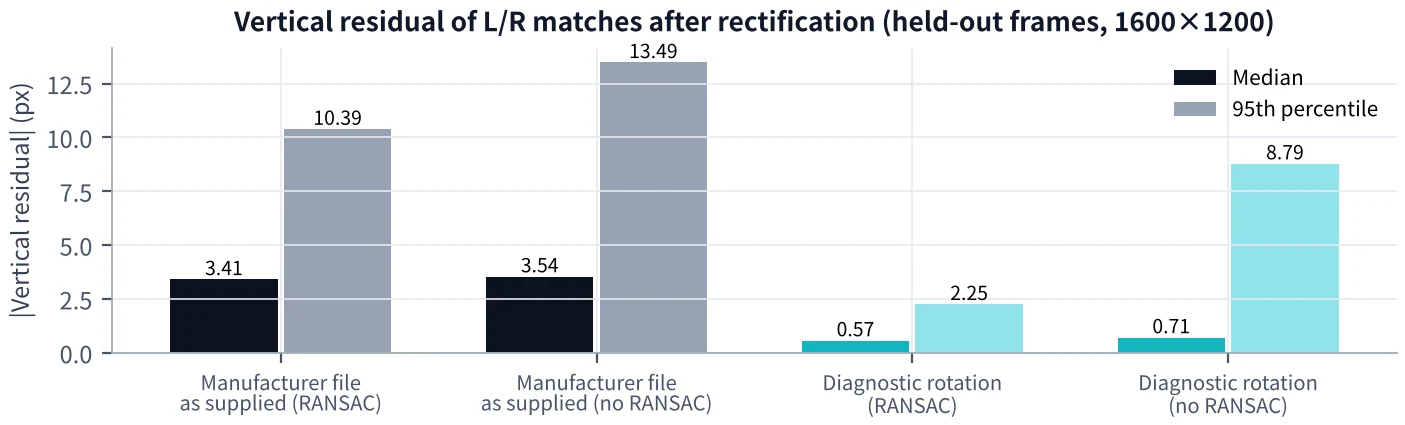
A Kalibr calibration produced in the same 1600×1200 capture mode was later validated on this recording without any adjustment: median angular epipolar error 0.41 px over the full field of view, with a stereo-rotation correction below 0.02°. The method and results are in Technical Field Note #04.
Evidence Status
What Is Verified, Estimated or Deferred
| Item | Result | Status |
|---|---|---|
| Video decode and format | 0 errors · 1600×1200 · 30/1 fps · 3,600 frames per channel | Verified |
| Source traceability | Stream copy · frame hashes and per-frame SEI preserved 3,600/3,600 | Verified |
| L/R frame correspondence | Frame tick 100% match · 0 counter gaps · motion correlation peak at lag 0 | Verified |
| IMU continuity and units | 501.7 Hz · 0 gaps / duplicates · 0 saturation | Verified |
| Video–IMU coverage | IMU spans 48 ms before first and after last exposure | Verified |
| Parsing reproducibility | Decoded CSVs regenerate byte-for-byte from raw files | Verified |
| L/R exposure synchronization | Median 20.5 µs (firmware record) | Device-recorded |
| Camera–IMU time offset | −1.1 / −1.2 ms | Estimated |
| Stereo epipolar consistency (this footage) | Mode-matched Kalibr parameters: 0.41 px median angular epipolar residual on 19,386 unfiltered matches (Field Note #04). Baseline scale and metric depth not verified. | Verified on evaluated footage |
| Camera–IMU extrinsics and time shift | Kalibr calibration available; not verifiable on this recording without a target | Kalibr-calibrated |
What This Evaluation Does Not Claim
This evaluation does not claim synchronization performance across all devices or modes, externally validated microsecond-level exposure simultaneity, production acceptance of stereo calibration, finalized camera–IMU extrinsics, or improved robot-learning performance.
Citable Technical Findings
Origin Data Lab evaluated a 120-second head-mounted stereo + IMU egocentric recording (2 × 1600×1200 at 30 fps; six-axis IMU). All 3,600 stereo frame-tick pairs matched; the device-reported median exposure-centre difference was 20.5 µs; IMU sampling averaged 501.7 Hz. The video–gyro time shifts of −1.1/−1.2 ms are estimates, not validated production offsets. A mode-matched stereo calibration achieved 0.41 px median angular epipolar residual on 19,386 unfiltered SIFT matches; this verifies epipolar consistency on the evaluated footage, not baseline scale, metric depth, or camera–IMU extrinsics.
How to Cite
Origin Data Lab (2026). “Stereo + IMU Egocentric Capture: Synchronization, Timing and Calibration,” Technical Field Note #03. Original technical note.
Related Technical Field Notes
Field Note #01: Video + IMU Capture Evaluation · Field Note #02: Egocentric RGB + IMU Task Sample · Field Note #04: Checking a Stereo Calibration on Ordinary Footage
Technical Evidence
Explore our public stereo and IMU evaluation evidence.
Request the Full Evaluation Package
Research institutions and robotics teams may inquire about access conditions for the source bitstreams, per-frame device timestamps, raw IMU measurements, decoders, validation scripts, QA records and technical evaluation materials.