Technical Field Note #08 · October 2026
How Much Egocentric Capture Is Usable? | Origin Data Lab
Integrity, task, sharpness and both-hands checks combined into frame yield, clip yield and capture hours per accepted hour — measured on 290 s of stereo and 132 s of phone capture
Buyers of egocentric robot-learning data pay per accepted hour, so the share of captured footage that survives acceptance sets the real cost. We measured it frame by frame on 12,651 frames: a full 290-second head-mounted stereo session and two 66-second phone recordings. Integrity checks removed almost nothing; sharpness and the both-hands rule did the filtering. Frame yield was 79% on the stereo rig and 57%–67% on the phones, but requiring clips of at least 3 seconds cut it to 46%, 12% and 43%. How hands are checked mattered as much as the footage: replacing a three-pass consensus with a single detector pass raised capture cost from 1.26 to 2.06 hours per accepted hour on the rig. Hand checks are AI-only and preliminary.
Problem
Accepted Hours, Not Recorded Hours
Egocentric data for robot learning is increasingly bought per accepted hour. What a capture partner can deliver, and at what price, depends on the yield — the share of recorded footage that survives the buyer's checks.
\text{capture hours per accepted hour} = \frac{1}{\text{yield}}Data
Three Recordings, Four Layers
| Layer | Rule | Source | Status |
|---|---|---|---|
| Integrity | Valid flags, frame interval 16.7–50 ms, ≥3 IMU samples per exposure (rig) / gyro coverage ±16.7 ms (phone), stereo sync ≤1 ms | Device timestamps and IMU | Verified |
| Task | Not inside a non-task keystep | Field Note #05 annotation (phones only) | Human annotation |
| Sharpness | Relative Laplacian sharpness ≥ 0.6; gyro rule (≤1.5 px or ≤20 °/s) when no still-frame reference | Field Note #06 method | Verified measurement (proxy) |
| Both hands | Both hands present under AI consensus | Field Note #07 method | AI-only preliminary |
Method
From Frames to Clips to Cost
accepted[t] = integrity_ok[t]                  # frame flags, timing, IMU coverage, stereo sync
            and not non_task[t]                # human keystep annotation (phones only)
            and rel_sharpness[t] >= 0.6        # vs low-motion frames within ±3 s; gyro rule if no reference
            and both_hands[t]                  # AI consensus: 3 MediaPipe passes, ±2 frames
clip_accepted = runs of accepted frames ≥ L seconds (optionally bridging gaps ≤ g frames)
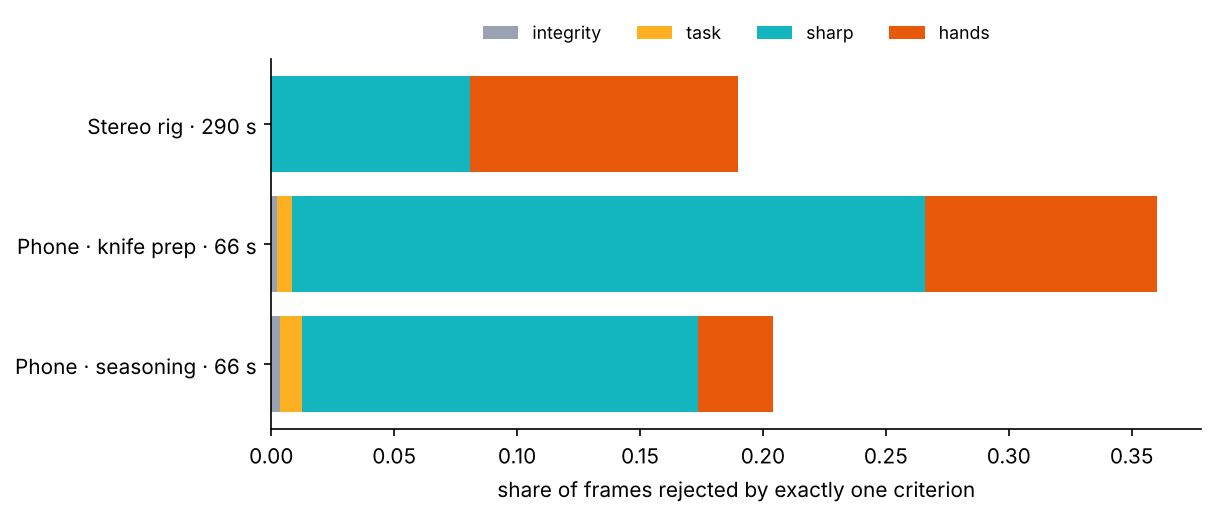
Frames rejected by exactly one criterion are counted separately, to show which rule is binding.
Results
Integrity Is Free; Sharpness and Hands Do the Filtering
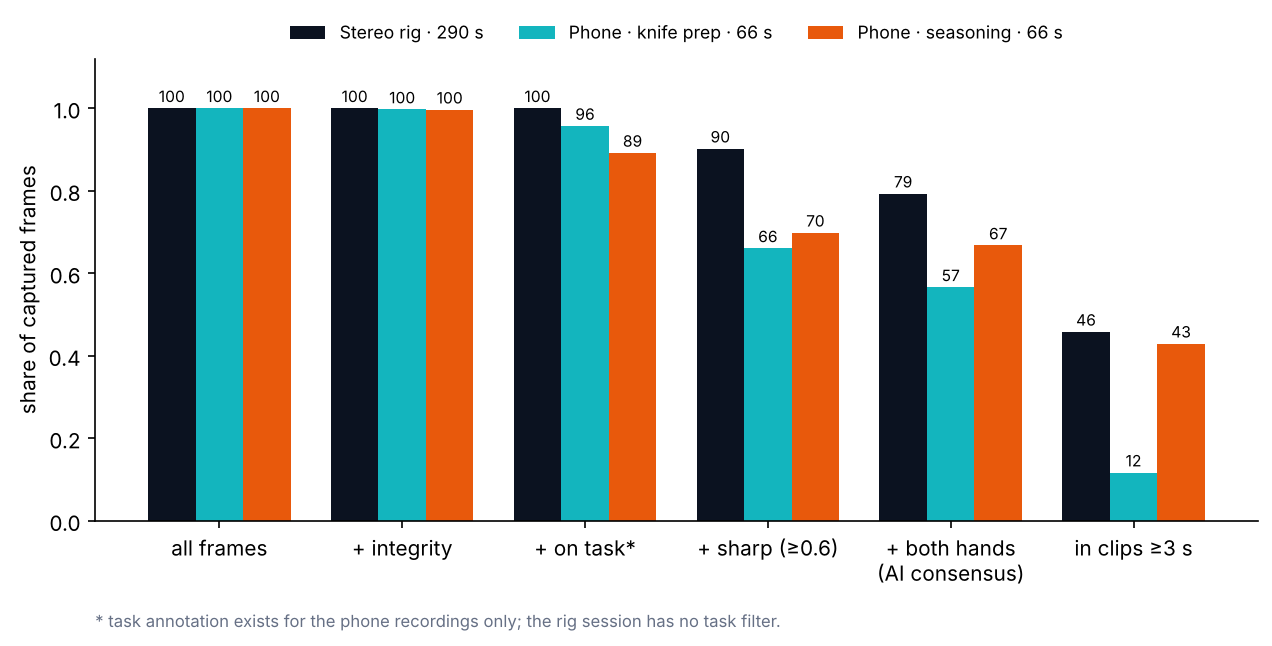
| Recording | Frames | Integrity | + On task | + Sharp | + Both hands | In clips ≥3 s |
|---|---|---|---|---|---|---|
| Stereo rig, full session | 8,694 | 100.0% | n/a | 90.2% | 79.3% | 45.8% |
| Phone · knife prep | 1,979 | 99.7% | 95.7% | 66.0% | 56.6% | 11.7% |
| Phone · seasoning | 1,978 | 99.6% | 89.2% | 69.8% | 66.7% | 42.9% |
Clips
The Acceptance Rule Moves Yield as Much as the Footage
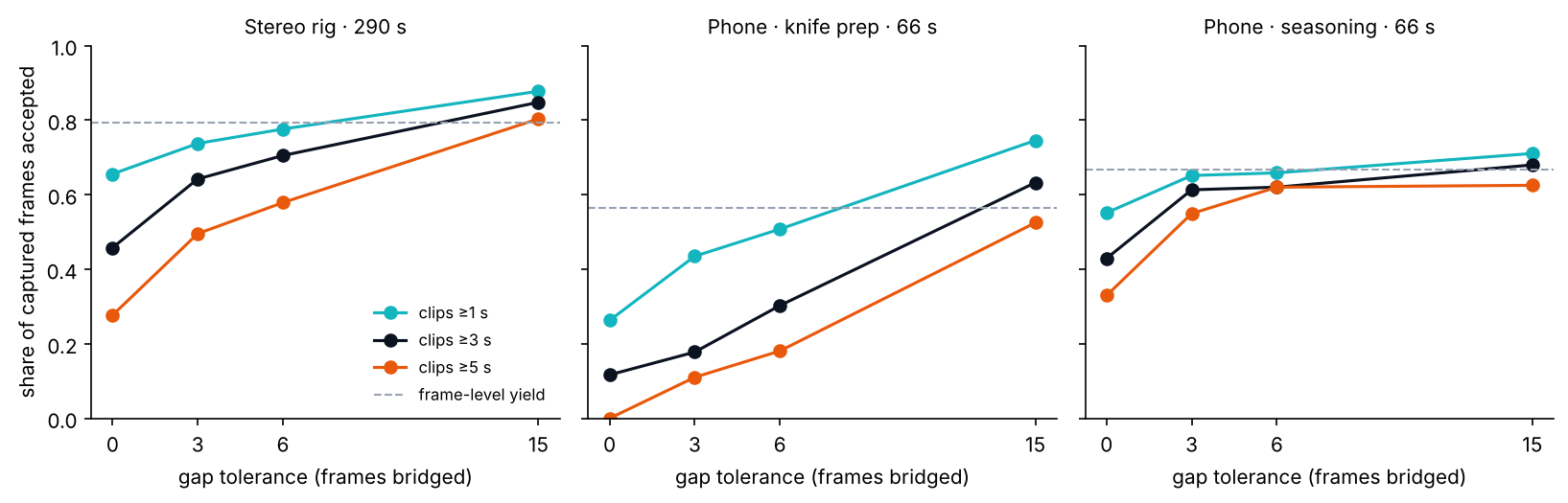
| Gap tolerance (frames) | Rig, clips ≥3 s | Knife prep, clips ≥3 s | Seasoning, clips ≥3 s | Rig, clips ≥5 s |
|---|---|---|---|---|
| 0 | 45.8% | 11.7% | 42.9% | 27.7% |
| 3 (100 ms) | 64.2% | 17.8% | 61.3% | 49.6% |
| 6 (200 ms) | 70.5% | 30.3% | 62.0% | 57.9% |
| 15 (500 ms) | 84.8% | 63.3% | 68.0% | 80.4% |
Cost
Capture Hours per Accepted Hour
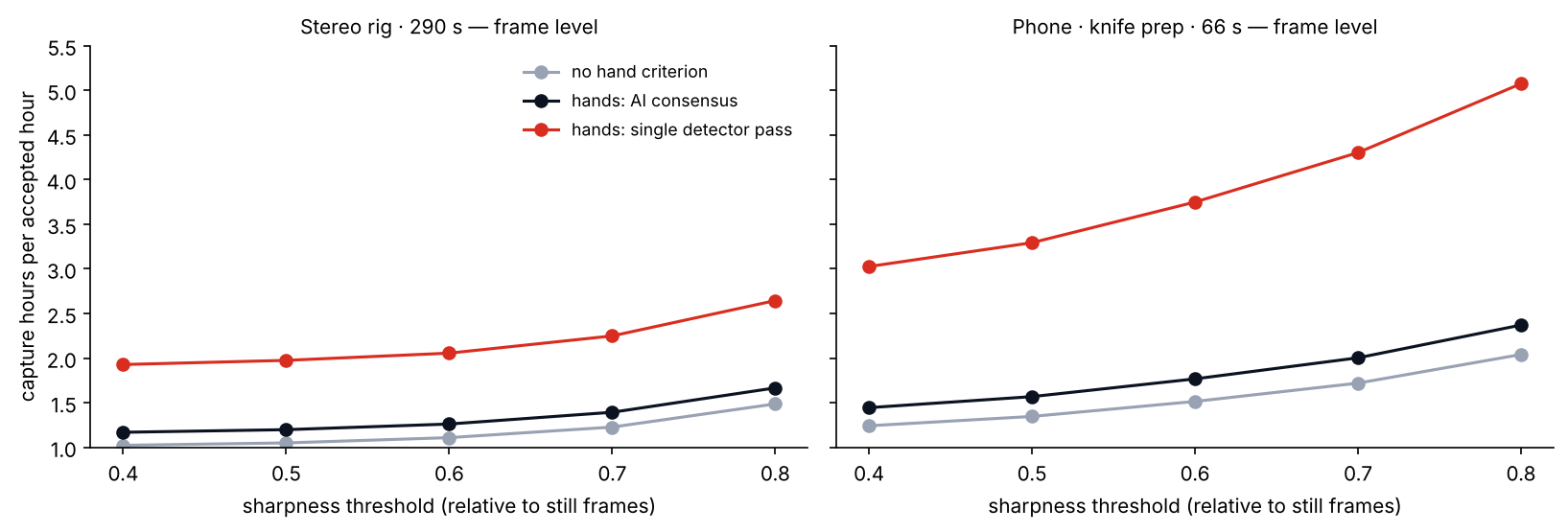
| Recording | No hand check | Hands: consensus | Hands: single pass | Clips ≥3 s, consensus | Clips ≥3 s, single pass |
|---|---|---|---|---|---|
| Stereo rig | 1.11 | 1.26 | 2.06 | 2.18 | 29.37 |
| Phone · knife prep | 1.51 | 1.77 | 3.75 | 8.57 | no clips |
| Phone · seasoning | 1.43 | 1.50 | 1.69 | 2.33 | 4.30 |
Stability
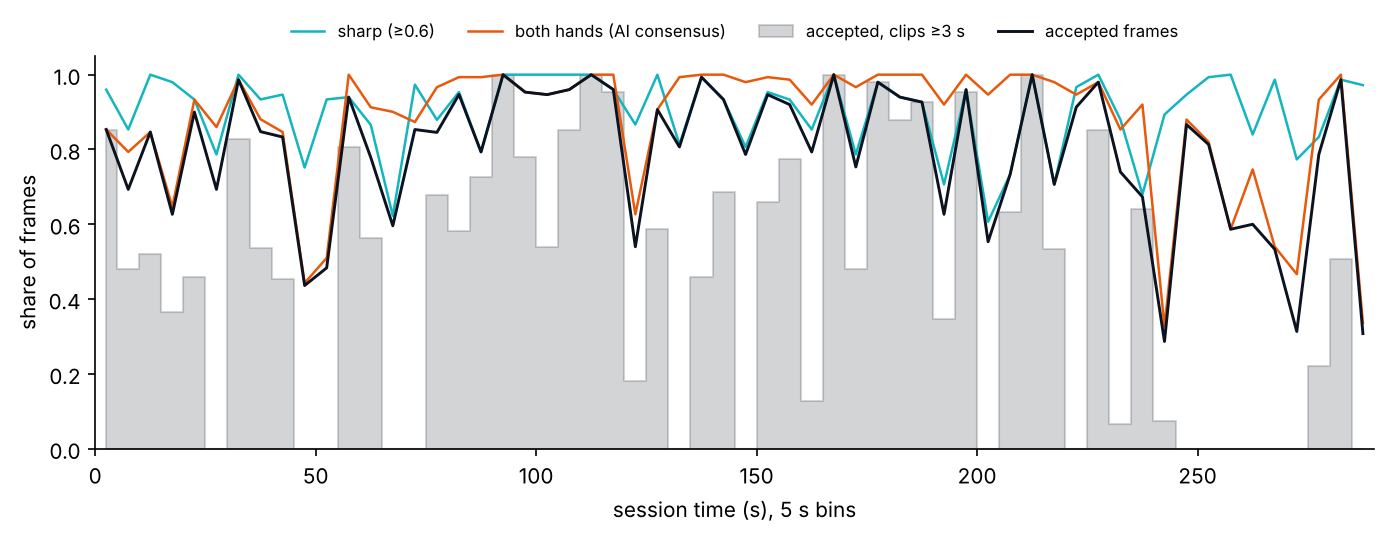
Yield Changes Within a Session
For Buyers
Five Terms to Fix Before Collection
| Term | Why it matters (this note) |
|---|---|
| Frame vs clip acceptance | Rig: 79% of frames vs 46% in clips ≥3 s |
| Gap tolerance | Rig 3 s clips: 46% → 71% with 6-frame tolerance |
| Hand-check method | Rig cost: 1.26 vs 2.06 capture h per accepted h |
| Sharpness threshold | Rig frame yield 86% at 0.4 vs 60% at 0.8 |
| Human sampling | Hand checks here are AI-only; misses depress yield (last minute of the session) |
Evidence Status
What Is Verified, Estimated or Not Evaluated
| Claim | Status |
|---|---|
| Integrity checks (flags, frame interval, IMU samples per exposure, stereo sync) | Verified — measured on every frame |
| Sharpness criterion (relative Laplacian sharpness ≥ 0.6) | Verified measurement; proxy for usability (Field Note #06) |
| Both-hands criterion | AI-only preliminary — MediaPipe consensus; per-hand recall vs AI review 92–99% (Field Note #07); no human verification |
| Task / non-task | Human annotation (phones only, Field Note #05) |
| Frame and clip yields, capture hours per accepted hour | Verified computation on the criteria above; inherits their status |
| Yield on other tasks, operators, sites | Not evaluated |
Reproducibility
Re-running the Analysis
python analysis/yield_analysis.py analysis/data/yield_frames.csv OUT_DIR
# OUT_DIR/yield_results.json is byte-for-byte comparable with analysis/yield_results.json
Limitations
- Hand checks are AI-only (MediaPipe consensus); no human verification. Missed hands lower the measured yield, as the last minute of the stereo session shows.
- About 7 minutes of footage from three recordings; two task families; yields are method demonstrations, not production rates.
- Sharpness is a proxy (relative Laplacian variance on H.264 video); it does not measure the effect on a specific model.
- The stereo session has no task annotation, so its yield excludes the task filter.
- Device, mounting, task and operator differ between the rig and the phones; differences are observations, not causal comparisons.
- Thresholds (0.6 sharpness, ±2-frame consensus, clip lengths, gap tolerance) are illustrative; buyers' acceptance rules may differ.
Frequently asked questions
What share of egocentric capture is usable for robot-learning data?
It depends on the acceptance rule. On our recordings, 79% of frames from a head-mounted stereo rig and 57%–67% from two phone recordings passed integrity, task, sharpness and both-hands checks. Requiring clips of at least 3 s cut that to 46%, 12% and 43%. Hand checks are AI-only and preliminary.
How many capture hours does one accepted hour cost?
At frame level with a 0.6 sharpness threshold and AI-consensus hand checks: 1.26 capture hours per accepted hour on the stereo rig and 1.50–1.77 on the phones. With a single hand-detector pass instead, the same footage costs 2.06 and 1.69–3.75 hours.
Why does the hand-detection method change the cost so much?
A single MediaPipe pass misses many visible hands (Field Note #07), so more frames fail the both-hands rule. Because one miss also breaks a clip, the effect is larger for clips: on the stereo rig, 3-second clip yield was 46% with consensus detection and 3.4% with a single pass.
Should acceptance rules allow short gaps inside clips?
Our data suggest the rule matters as much as the footage. Bridging rejected gaps of up to 6 frames (0.2 s) raised 3-second clip yield on the stereo rig from 46% to 71%. Bridged frames are themselves below threshold, so the tolerance should be agreed explicitly with the buyer.
Which criterion rejects the most footage?
Sharpness on the phone recordings (22%–31% of on-task frames failed) and the both-hands rule on the stereo rig. Integrity checks rejected 0% of rig frames and about 0.3% of phone frames (the last ~0.2 s without IMU and one long frame interval).
Does yield stay constant during a session?
No. Per-minute frame yield on the 290-second stereo session ranged from 61% to 89%. The lowest minute coincided with many missed hands while the wearer held a drill; an AI visual spot check of six frames from that minute saw both hands in all six, while the consensus missed both hands in three.
Are these yields guaranteed for a production project?
No. They come from three recordings (about 7 minutes), one task family per recording and AI-only hand checks. They demonstrate the method; production yields must be measured on the buyer's tasks and agreed acceptance rules.
RESEARCH RESOURCES
Explore the Technical Resources
Access the code, datasets and evaluation materials.